First of all, there is seemingly a misunderstanding about my Pathfinder Campaign Setting. There is a problem with blogs, they tend to put your latest post first. I worried over this, and apparently my worry came true (the Law of Attraction really works, folks! I deeply admonish you to learn it!)
Anyhow, it's nice that people come out and say that they won't be players in my campaign for one reason or another. However, it's frustrating. First of all, my campaign is not directly related to Ancient Sparta. As much as I know about that city state (with a government that's really hard to wrap a mind around), Sparta is not the primary inspiration for my campaign.
Hercules: the Legendary Journeys T.V. Show, produced by Sam Raimi, is. Frustrating as it sounds, yes I know. Because of a foolish law that has been made obsolete by the Internet, Pheonicia won't be officially apart of the Golarion universe. In order to survive as a writer on a planet with an Internet, you either have to support measures to limit Free Speech and further Limit Free Press, like RIAA and MPAA do; or you just have to accept that the Internet exists and use it's community for your gain.
Ahem. That and I'm not a fan of Golarion. It's a great setting, but the whole idea of the Original Dungeons and Dragons game is that you work with your own ideas. So, as a result, I'm writing the Player's Guide to Phoenicia to bring everything together so that you will know, at last, that my setting has nothing to do with Sparta.
Harrumph. Now that everything is clear, lets move on, shall we?
The armies of Phoenicia is made up of footsoldiers comprised of fighters, warriors and psychic warriors. Over half of Phoenicia is protected by the Hoplite army. The other part is made up of Vedan warrior units.
So far, Pheonicia had to go to war only twice since the Hellenic conquest. But the city had to defend itself from invaders numerous times. The army it has is mostly made up of non-psychics, but there are three units of Psychic Warriors that defend the city. The units are:
Ares' Sons Athena's Pride Rama's Knights
Ares' Sons
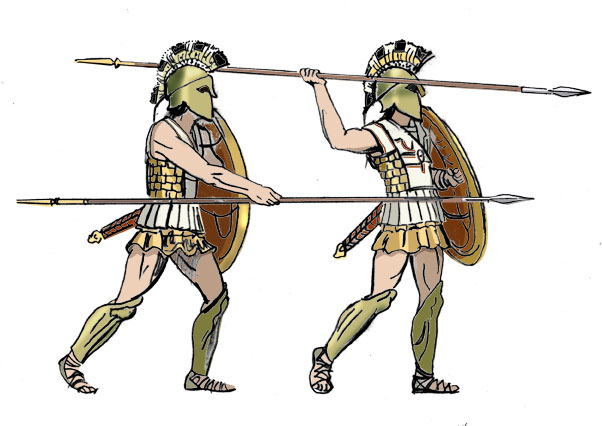
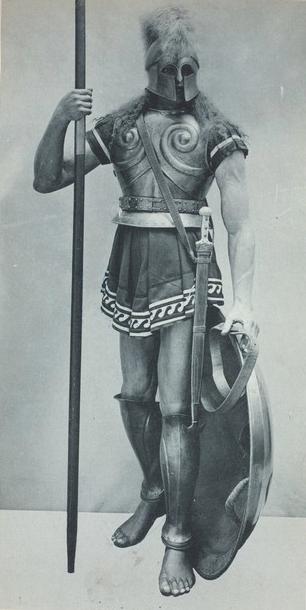
Ares' Sons is a Hoplite unit that is comprised of Psychic Warriors. Armed with an aspis, greaves, and cuirasses the Psychic Warrior hoplite is often ready for battle. The helmet they wore is the Corinthian helmet, and the weapons they bear are the dory (spear) and the xiphon (short sword). The hoplite panoply is considered to be AC 14 when constructed out of bronze, and AC 16 when constructed out of iron.
From Wikimedia, in the public domain.
Ares' Sons are located in a fortress built to train their number. The fortress includes a temple to Ares. Also called the Spartiates or the Sparti, Ares' Sons are relentless in battle. When on the field, they are strike fast, and they strike hard. They are decisive, and able to destroy the enemy in a relentless advance.
Ares Fortress
The fortress of Ares' Sons include the following:
Temple dedicated to Ares -- the temple dedicated to Ares has priests of the War God sacrificing goats. The temple doubles as a Martial Arts dojo where the tenants go to worship the God of War by learning Martial Arts. Here, they perfect their use of the spear, the aspis, the sword, and learn unarmed martial arts and grappling.
Other rooms of the temple are dedicated to offensive tactical maneuvers, tactical studies of other kingdoms (they have a copy of The Art of War) and military history.
Here the following feats are taught to young psychic warriors of the Ares' Sons unit: General Warrior Feats:
Combat Reflexes, Power Attack, Improved Bull Rush, Defensive Combat Training, Improved Sunder, Dodge, Improved Overrun, Cleave, Great Cleave, Endurance, Weapon Focus, Greater Weapon Focus
Psionic Feats:
Psionic Talent, Psionic Weapon, Greater Psionic Weapon, Deep Impact, Focused Sunder, Speed of Thought, Psionic Charge, Combat Manifestation
Psionic Feats from Bruce R. Cordell'sHyperconscious:
Dorje Blade, Psychic Bastion, Wounding Cut, Wounding Resonance, and Visceral Surge.
Weapon Master Nicodemos
Male humanCleric of Ares 4/Psychic Warrior 10
Nicodemos is the main trainer at Ares' Fortress. He oversees the training of Ares' Sons units. He's fifty seven years of age, so he trains his students well in the Martial Arts. He has several assistants helping him. Nicodemos also oversees sacrifices to the God of War, Ares.
Creche of the Mind -- Here, young children are subjected to the awakening of their psionic powers. Mostly the children of the psychic warriors themselves, the young children sleep here among resonant crystals in hopes of them developing psychic abilities with the onset of puberty. If successful, they then will undergo training as a psychic warrior, soulknife, or psion. Those that escape but develop psychic powers either gain the Wild Talent feat or develop into wilders.
Barracks and Messhall -- Here the unit sleeps and a mess hall is constructed to allow them to eat.
Created by me in the Classical style.
Psychic Surgery -- Its important that wounded soldiers are treated quickly. Medicine is of Iron Age quality. The army doctors employed here are as knowledgeable as Galen of Pergamon. They are students of Asclepius and are dedicated to the healing of soldiers. Some are clerics of Asclepius, others are psions specializing in psionic healing.
Persian Tower -- four minarets done four round towers. Here, psionic archers defend the parapets.
Command Circle --a psionic item that allows the commander of the phalanx to oversee how a battle at the fortress is progressing.
Staff -- the Fortress is fully staffed with all the staff one needs. Armorers, a couple of cooks, a few architects, some weaponsmiths, and a few engineers to maintain the fortress.
THE SPARTIATE
Spartiates are warriors that are specially trained Psychic Warriors, Warriors, or Fighters that make up a special unit that is attached to Ares' Sons. Inspired by Cadmus slaying the dragon and then sowing the dragon's teeth to create an uncommon warrior of Thebes, Spartiates are a special crack unit made up of those who are devoted to Ares' teachings. In short, they are trained as an elite unit.
Having mastered the martial arts of the aspis, the dory, and the xiphon, a Spartiate would further train as commandos, having uncommon bravery in the face of greater odds. They are also trained to handle most any terrain while fighting, and can fight not only in formation but out of formation. A spartiate was a master of martial arts, and a dabbler in others. The Spartiates have proven themselves several times over when the unit of Ares' Sons had battled invaders from the south. PC Spartiates -- also called Errant Spartiates -- are expected to be in the field, learning their skills the hard way. PC Spartiates are expected to be tough and to return to the unit to eludicate on what they've learned. NPC Spartiates -- or commando Spartiates -- are expected to stay and drill and keep their skills in top shape until the next time they are called upon to go to war.
4th Century Hoplite by Johnny Shumate.
Role: Spartiates fulfill the role of the commando in the world of Terre. They are crack army specialists where some of them are errant and some of them are not. They fulfill the role of the Green Berets, the British Commando, and the U.S. Army Rangers. Veteran Spartiates often hire themselves out as professional mercenaries.
Alignment: Most Spartiates are lawful in alignment. While some are chaotic, most tend to be lawful because of the regimented lifestyle they live. Spartiates that develop a chaotic neutral alignment during battle, however (say, develop psychoses because of battle) are often treated psychologically in the hospital ward. Choatic evil Spartiates are often deemed untreatable or unredeemable (although there are exceptions) and still are found in the ranks, where it is hoped that they will die.
Hit Die: d12.
Requirements
To qualify becoming a Spartiate, one must fulfill all of the following criteria.
Skills: Climb 5 ranks, Knowledge (Tactics) 5 ranks, Perception 6 ranks, Stealth 5 ranks Feats: Combat Expertise, Improved Unarmed Strike, Weapon Focus (Spear), Weapon Focus (Short Sword) Psionics: If the person entering the Spartiate is a Psychic Warrior, Psion, or Wilder, he must be able to manifest 3rd level psionic powers. If the person entering the Spartiate Class is a Soulknife, he must be able to demonstrate the Mind Shield and Powerful Strikes weapon skills.
Class Skills
The Spartiate's class skills are Acrobatics (Dex), Climb (Str), Intimidate (Cha), Knowledge (Tactics) (Int), Knowledge (Strategy) (Int), Knowledge (Military History) (Int), Perception (Wis), and Stealth (Dex). Skill Ranks per level: 4 + Int Modifier.
In this post, I'll be going over the religious climate of Phoenicia. Phoenicia is gripped strongly by an air of personal and individual freedom. Although there will always be those that will try to take away the freedom of the people -- both Foreign and Domestic, the Phoenicians have held these forces at bay. As a result, the entire city has a law protecting the freedom of worship.
As a bizarre result, the city harbors many, many religions. However, the dominate religions can be classified as Monotheistic, Polytheistic, and Atheistic. The religions are discussed below.
RELIGIONS OF MANY GODS AND NO GODS
Hellenism
Hellenism is the worship of the Dodekatheon or the Twelve Olympians. Supreme in the Dodekatheon is Zeus, with Hera as his queen, and so forth. However, Hellenist priests are slowly merging with the Hindus. Zeus is seen as an aspect of Indra, and vice versa. Phoenician Hellenism has also adopted the Hindu trimurti. Saturn or Chronos is an aspect of Brahma, likewise Shiva is seen to be an aspect of Ares. Finally, there is Vishnu, whom the Hellenists have identified with Apollo (which isn't true, Vishnu isn't associated with the Sun like Agni is).
Hellenism is extremely popular among the middle and lower classes found in the Northern Lower City. Especially the magic cults associated with Hecate -- who is identified with Khali. Still, Hellenistic schools of science and natural philosophy say that the Gods are false and that the School of the Scholars which venerates the Force of Good is the only one to follow.
Domains: The Domains of the Dodekatheon are found in the Dungeons and Dragons book Deities and Demigods.
Hinduism
Also called Vedism, Hinduism is the worship of many Gods, and it is one of the hallmarks of Vedic culture. Centered in the Upper Southern City, the Hindus worship a multiplicity of Gods and believe in reincarnation. The main gods are the Hindu Brahma, Vishnu, and Siva with a multiplicity of many gods (including Agni, Khali, Indra, and others). Hinduism promises salvation through good works (Kharma) and teaches Reincarnation.
Brahma is seen as the Creator. The god Brahma created all things in Hindu religion -- being the god that brought order out of Chaos. Brahma is often protrayed as having four bearded faces and four arms, studying the Vedas, and riding on a white goose. His wife is Sarasvati.
Domains: Brahma is a greater God and has lost prominence over the years among Hindus. His domains are Air, Law, Good, Glory, and Knowledge. His subdomains are: Agathion, Cloud, Archon, Honor, and Thought.
Siva is a God of duality. He is is a major Hindudeity, and the Destroyer or transformer among the Trimurti, the Hindu Trinity of the primary aspects of the divine.[2] In the Shaiva tradition of Hinduism, Shiva is seen as the Supreme God. In the Smarta tradition, he is regarded as one of the five primary forms of God.[3] Followers of Hinduism who focus their worship upon Shiva are called Shaivites or Shaivas (Sanskrit Śaiva).[4]Shaivism, along with Vaiṣṇava traditions that focus on Vishnu and Śākta traditions that focus on the goddessShakti, is one of the most influential denominations in Hinduism.[3]
Shiva is usually worshipped in the abstract form of Shiva linga. In images, he is represented as a handsome[5] young man[6] immersed in deep meditation or dancing the Tandava upon Apasmara, the demon of ignorance in his manifestation of Nataraja, the lord of the dance. It is said that he looks like an eternal youth because of his authority over death, rebirth and immortality. He is also the father of Ganesha and Murugan.
Domains: Shiva's Domains are Chaos, Destruction, Good, Knowledge, and Liberation. His subdomains are Azata, Catastrophe, Agathion, Memory, Thought, and Revolution.
Vishnu is the Supreme God in the Vaishnavite tradition of Hinduism. Smarta followers of Adi Shankara, among others, venerate Vishnu as one of the five primary forms of God.[1]
The Vishnu Sahasranama[2] declares Vishnu as Paramatma (supreme soul) and Parameshwara (supreme God). It describes Vishnu as the All-Pervading essence of all beings, the master of—and beyond—the past, present and future, one who supports, sustains and governs the Universe and originates and develops all elements within. Vishnu governs the aspect of preservation and sustenance of the universe, so he is called 'Preserver of the universe'. Of the three members of the Trimurti, the Bhagavata Purana, which espouses the Vaishnavite viewpoint, explains that the greatest benefit can be had from Vishnu.[10] Domains: Vishnu's domains include Glory, Good, Healing, Knowledge, and War (based upon Rama, Krishna, and Kalki). Subdomains include Heroism, Archon, Restoration, Memory, and Tactics.
There are other gods, of course, but they are too numerous to include in this blog post.
Jainism
Jainism is very small, but highly influential in the city state of Phoenicia. Jains are centered in the Southern Lower City, and are a minority. Still, their ideas and thoughts have impacted Phoenician culture. Jains are strict pacifists, so many do not find the adventure that heroic player characters do. Some are also extreme aesthetics. The Jains came with the Spice trade, seeking religious freedom. Their impact on Pheonician culture is small but significant. Jains could be said to worship the Atman, but Jainism is an atheist philosophy.
Domains: Jainism grants Good, Knowledge, and Healing as domains but has no subdomains.
A monotheistic religion, an analog to Zoroastrianism exists in Phoenicia that is called Dravidism. But for our purposes -- since a duck is a duck, why call it a horse? Zoroastrianism is an ethical monotheism that was taught by Dravid in the East, and had come to Phoenicia by the Sword and the Book. In ancient Persia, Zarathustra was the main prophet, changing a nation of polytheists into monotheists. In the world of Terre, Dravid did the same thing and Dravid taught many of the same concepts: History is lineal, and at the end people will be judged against the Laws which God gave. Also, the faith includes a concept of premortal life, mortality, and an immortal afterlife. Zoroastrianism is found in all districts of the city and is the city's predominate religion. Aside from Islam, which does not have an analog or exists unto itself in Terre, Zoroastrianism has a strong impact on Medieval Persian Culture, and is included for flavor reasons.
Domains: The God of Zoroastrianism, in Phoenicia, has some parallels to Brahma. However, as concepts are taught through the ages, the concept of the Zoroastrian God grants clerics the following domains: Community, Good, Law, and Healing. No subdomains are included in Zoroastrianism.
The Spirit
The Spirit is a faith that predominates the Upper North Quarter of the city of Phoenicia and is especially popular among Psions, Psychic Warriors, and Soulknives. Clerics of the Spirit call the thing they worship "the Father." Concepts of the Spirit is surprisingly similar to the Atman of Jainism, the only difference is that the Spirit is worshipped in this religion.
In fact, the religion is the Unreligion. Clerics have priesthood but are not organized into a religion. Tenants of the Spirit will not tell someone what to believe or how to believe. There are no set ordinances, no apostles, no high priesthood. People are allowed to live and believe what they want to believe so long as they worship the Spirit and believe in a Savior to save them from their failings. People who join the faith are expected to have a spiritual experience to show their personal relationship with the Spirit. The faith includes everyone from the depraved and the politically insane, to the brave and the cowardly, to the heroic and the stoic. Believers believe they are gods, that they have a personal relationship with the Spirit, and strive to live and enjoy life: whether they be evil or good.
Domains: This unreligion grants all domains, the Cleric of the Spirit need only to choose two domains.
I have a lot more I want to talk about this city state!
Phoenicia, although named after the real life Canaanite nation of the same name, is nothing like the same city state. Named after the legend of the Phoenix, Phoenicia is a place about beginnings rather than endings. Settled by a majority of Vedan refugees that escaped invasion by moving North and away from the invaders path; Pheonicia is a mixture of Vedic and Known World (Hellenic) culture. The Vedans brought with them their religions and their beliefs. But they also brought with them Psionics.
Like a Phoenix, Vedic culture was reborn. Although, it's mixed with Known World culture, there is a big contribution of Vedic Culture. Phoenicia is the center of government for the Phoenix Valley. Located on a fertile plain between two ranges of hills, it's a city like no other. Phoenicia is an important traderoute along the Silk Road and the Spice Route. With the Silk Road leading into the Eastern Realms, and the Spice Route leading back to the Vedans' ancestral lands; Phoenicia's ties to the Known World allow the city to be an important trade route on the East.
shots by jacob of the falls, published under the GNU Free Documentation License.
Through the valley flowed the river Sardis, which plunges down a cataract waterfall before emptying into the sea. Once, Phoenix came here and staked a claim and founded a tiny trading outpost. That was many generations ago, and now Centuries later the city of Pheonix is divided across the Sardis River into the North Upper City and the North Lower City, the South Upper City and the South Lower City. The city practically surrounds the cataract. With refugees from invasions coming in nine hundred years after the city was founded, the city had blistered almost half it's current population. With the invasion of Helenes two hundred years ago, Phoenix has become the Known World's eastern most city with an unusual culture and a door way along the Silk Road. Now, the people have perfected their government into a Republican form of government when the last of the Scions of Phoenix was killed during the Hellenic invasion.
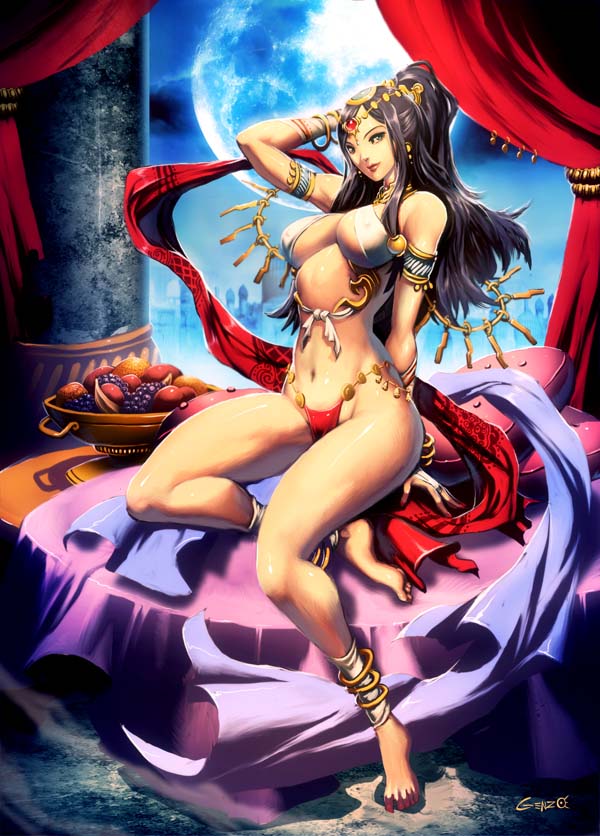
Morgiana the Clever by Genzo [http://genzoman.deviantart.com/gallery/11977572?offset=96#/d1m9f7x]
Now the city is under the wise rule of the Senate and the House of Representatives. The Senate is charged with foreign affairs and is made up of the Aristocracy of the city. The House is charged with domestic affairs of the city and is made up of the Middle Class of the city.
Besides being renowned as the capital of the Metacreativity Discipline, Phoenicia is renowned with the finest forges in the region as well as the finest crystal craftsmen. It is also renowned as the source of glyss -- a substance created by infusing glass with vaporized copper. Thanks to the fact that the hills surrounding Phoenicia still produces about one hundred talents of malachite, chalcocite, and tetrahedrite a year. Phoenicia has to import tin in order to make bronze, and it also has to import iron from the mountains that are one hundred miles to the North.
However, the silk and spice trade brings in silks and spices. Spices such as cinnamon, pepper, tumeric, and saffron come into the land along the trade routes. Spice shops are really popular in Phoenicia, since there are large bags in which people can buy their supplies.
Taken by judepics. Republished according to the terms of the CC-BY-SA license.
As a result, nearly any tool, weapon, or other metal and crystalline weapon can be found and crafted here. and the quality of their alloys and castings are quite unsurpassed in the Eastern part of the Known World. As a result, Phoenicia has a large population of craftsmen working in the Crafts District of the city -- located in the Southern Lower City. Also, an influx of guilds from the Known World had come into Phoenicia. As a result, the House has passed laws that limit the Mercantile nature of the guilds and to promote free trade.
Phoencia's Statistics
NG large city
Corruption +0; Crime +2; Economy +5; Law +2; Lore +5; Society +2
Psionics in my world plays a very important part. For Magic, Arcane and Divine, descended from Psionics during the End of the World. When the Lemurians and the Atlanteans came to the world, they brought psionics with them. Shapers shaped the world according to their will, savants moved matter with their minds, nomads teleported through the world, Egoists learned how to control their own bodies, telepaths can receive and transmit thought waves at will, and Seers see into worlds beyond sight.
Then everything changed. A great cataclysm happened, destroying the civilizations of the Lemurians and the Atlanteans. The Great Cataclysm resulted in the destruction of human civilization and the appearance of other civilizations. The Coming of the Elves, for instance -- the orcs, and others came through their own gateways. To escape, some of the Atlanteans and Lemurians went into the hollow of Terre. Those left above were forced to survive.
The powers and knowledge of psionics was completely lost for a time (through the Copper and Bronze Ages). However, as Mankind rebuilt himself, he learned magic from the elves. But psionics was preserved in the mythical kingdom of Vedicia. During the Early Iron Age, psionics filtered out of the Spice Route, reaching the known world. In time, three cities -- Phoenicia, Syracuse, and Sybaris became the three main human cities that had a majority of psionic populations.
The influx of psions, psychic warriors, soulknives, and wilders came during a combined army of Human, Dark Elf, and Orc army invaded Vedicia and absolutely destroyed most of the Vedan Civilization. However, some of the psions struck back, overthrowing their oppressors in little of 100 years and fracturing their little empire. But the damage was done -- if it was damage. The seeds of psionics have been spread throughout the world.
The Three Psionic Cities of the Known World
Phoenicia
Phoenicia is the most Eastern city in the Known World. Pheonicia's culture is an ahistorical mixture of Hellenic, Vedic, and Medieval Persian culture. The people dress strangely in silk and cotton outfits. This is simply because Phoenicia is beyond the Dragonwall and the Hordelands near the desert and in warmer climates. Most people in Phoenicia wear very little, being affected by Vedic fashion, it seems. While others wear a lot of clothing because of the proximity to the desert. A few are outright nudists. But this is mostly because of the Pheonicians' beliefs.
A Phoenician by Genzo [http://genzoman.deviantart.com/]
They believe that they are literally gods, so their whole government is based on government by the Self. They have not conquered poverty, but they believe they are free and their city state is ruled by a Republic -- a Representative Form of Government (the representatives make laws, and the people govern themselves -- little laws are needed). The main discipline being taught here is Metacreativity.
Fashions range from Skyclad (nude), to revealing clothing that leaves very little to the imagination, to costumes coming out of the Tales of Sinbad, to Arabian Dishadi Thobes. Veils and burqas are simply not in vogue. Phoenician fashion is often handmade from cotton and or silk, and ranges from the simple to the extravagant.
Hero Classes (Pathfinder, D&D 3.5): Psion (all disciplines, although Metacreativity is prominent) Psychic Warrior (Main warrior paths include Brawling, Mind Knight, and Weapon Mastery paths) Soulknife Wilder (prevalent among the poor and destitute, where they can't get proper psionic training)
Hero Classes (4e, see the Player's Handbook 3):
Ardent
Battlemind
Psion
Other Disciplines (i.e. Prestige Classes):
Metamind (Psionics Unleashed/Expanded Psionics Handbook) Chakra Savant (Bruce R. Cordell's Hyperconscious/Mindscapes)
Dream Keeper (Hyperconscious/Mindscapes)
Dream Wright (Hyperconscious/Mindscapes)
Plangent (Hyperconscious/Mindscapes)
Psychic Chirurgeon (Hyperconscious/Mindscapes)
Spirituel (OGL version of the Ardent -- Hyperconscious/Mindscapes)
Paragon Paths (4e, again see the Player's Handbook 3):
Argent Soul
Psionic Binder
Eternal Blade
Steel Ego
Cerulean Adept
So, where does someone begin when they make a setting for Pathfinder or for D&D (4e or any other edition)? Everything every where begins as a idea. Usually out of the Zeitgeist (there's that word again). So you start with an idea. Where do people get their ideas from?
Well, you can thank God that we don't live in a vacuum of human expression. The Corporate World, however, demonize God because we don't live in a vacuum of human expression. Nina Paley wrote on her essay "The Cult of Originality" this:
How peculiar, then, that Michelangelo's works showed up in Europe in the 16th Century, rather than ancient Egypt or Sumeria or Persia, or in the Lascaux Caves? How “original” was Michaelangelo? He used the language and techniques of his time. He carried ideas passed to him by his neighbors. He didn’t create in a vacuum. [1]
Neither does the Dungeon Master. To say a setting like Glorion, or Eberron, is original is to be conceited. Eberron has strong Steampunk roots. Something you get from Gibson's writing about how Babbage's calculator machine had become common place, or Sony's Steam Boy. Glorion draws heavily on several tropes in the Genre. Especially some Tolkien, making it an unremarkable setting for some (especially me). I want to do something REMARKABLE, different, and . . . as I said in my previous Essay . . . obvious.
I've written on numerous occasions about orcs on this blog, and while they are all cool, I didn't pay enough attention to humans. How can you get orcs and humans to interact and make humans interesting to play at the same time? (I'm currently playing a Worgen mage on World of Warcraft, and I've become sick of how clichéd the humans are). I want something not a cliche for my humans. With several tribes of orcs, all different, they don't need a culturally homogeneous human race to fight against. Not every human nation needs to be a knock off of High Middle Ages England with American Accents. In a sense, Tolkien has dominated American fantasy . . . with a few off shoots like Mar Barker or John Norman, for a very long time. It's like we are in a dark age of American fantasy and dreams -- Tolkien, who is acclaimed as a genius, has been copied. Copied! so many times that many of the things you see in a present day American Fantasy novel is full of clichés. What happened to Edgar Rice Burroughs or Robert E. Howard?
Where does one turn to get ideas to set up a remarkable campaign setting?
to create interesting nations for the orcs to fight and contend with, I go by a few simple rules:
* Don't look at Tolkien. Tolkien, while original in his day in creating a Myth for his time, has been copied so much that many of his work has become clichés in D&D settings the world over. Tolkien can be admired for a source of inspiration, but not to take whole Cloth. Like Disney did when they crossed out the Roman Portico for Atlantis, I have to cross out Tolkien.
* Look at Frank Frazetta's paintings. While the OSR movement flocks around Frank Frazetta, not a lot of what he painted are clichés in the standard D&D campaign setting stuff. And most of what he paints is American Fantasy.
* Look to the Sinbad movies. Sinbad and the 1001 Arabian Nights in which the tales of Scheherazade is the inspiration of these movies. Sinbad's voyages as told by Scheherazade are the inspiration for many movies set in Persia, Arabia, and Baghdad. Some interesting links: Sinbad: Legend of the Seven Seas
(Anything with Sinbad is good, even the T.V. series).
* Ray Harryhausen is the seminal inspiration for a generation of filmmakers. He revolutionized the special effects industry until computer graphics dominated the scene.
Finally . . .
Ancient History and the Bible.
All of these used to contain clichés, but now not a lot of people know about them or read about them. They are often locked up in stupid Copyrights that are jealously guarded by people who have either lost their talent, or they sit on their Grandfather's legacy and rip the rewards. ( Copyright is a bad thing).
And the bible? Hardly anyone makes movies from it anymore. Despite historical accuracy; although Samson would be great to make a movie about (everyone loves an Anti-hero).
Ahem . . . 12 hooks, from different sources other than Tolkien. NICE! :)
So, to create something remarkable you need to get off the beaten path. Tolkien has been, to put it nicely, copied to death. There's loads of literature to draw your ideas from -- the above is just the tip of the iceberg. To create your setting, you need a hook or an idea. Stay away from what everyone else is doing and look at everything else no one else is looking at. Even if it's a series about Gor (John Norman), Conan the Barbarian (John Howard), or Sinbad (1001 Arabian Nights).
Halflings (player) -- Another human genetic redesign -- although by natural forces. Halflings also come from another planet; but the planet they came from is a water world of Archipelagos and not continents. Evolution has created them over millions of years of natural selection. Most halflings are usually forward -- adopting human customs. Others cling to their tribal heritage.
Gnomes (player) -- Little space aliens that look human; the origin of the gnomes are unknown. They live longer than humans and thankfully; are a rare species.
Dwarves (player) -- Dwarves are also space aliens. They also look human, but their smaller, tougher frames and genetic differences fail to produce perfect offspring. Half dwarves and half humans are known as mulls (pronounced ˈmyül as in mule).
Goblins (non-player) -- Monstrous humanoid aliens also from another planet. The goblins are a defeated enemy of the Ancient civilization. Goblins in the Known Lands are the descendants of traitors and prisoners of war after the Second Interstellar War. Mostly a tribal society of primitives, most goblins retain an inherent genius for technology. Most people often don't realize that the goblins and their genius -- during the Second Interstellar War, the goblins were the leaders of the opposing civilization that fought the ancient humans and their allies.
Hobgoblins (non-player) -- Hobgoblins are genetic redesigns of goblins. The goblins created them to be the warrior caste (with the goblins being the science caste) of their original civilization. Bred for war and violence, the hobgoblins are a larger and human sized version of the goblin. They are warriors first and thinkers second. Although in the millions of years since the second Interstellar War, the hob-goblins live in isolated tribal societies and developed a culture built around honor. Hobgoblins are typically ruddy -- a reddish brown color offsetting the brownish green of the goblin.
Bugbears (non-player) -- Brutish goblin redesign, the bugbears are meant to be shock troopers; elite troops that were abandoned because of their ferocity. Bugbears still exist in the Known Lands, and are hard to deal with. An infestation of bugbears means violence in short order.
Ogres (Non-player) -- When the goblins conquered Archaeri and most of Outland, they found the Orcs. Using their weird science, the goblins managed to recreate humans from Orc DNA, and studied the orcs. Then they genetically redesigned a few of them to be even more primitive and monstrous. The result is the ogre, a human genetic redesign that incorporates goblin DNA with the human DNA. The goblins then enslaved the orcs, made them worship demons and turned them into a powerful force to use against their enemies: the Ancient humans.
Using "magic" the orcs and ogres were unleashed on the home planet of the Ancient humans; the Known Lands. The goblins were ultimately defeated in the Second Interstellar war, but ogres exist in the Known Lands. They are primitive, savage, backward, and dangerous. As a human genetic redesign, human and ogre relations do produce half-ogres.
Centaurs (non-player) -- Centaurs were allies to the humans during the First and Second Interstellar Wars and a colony was allowed to settle in the Known Lands. They aren't prolific, but Centaurs exist everywhere. Wemics were also allies, and have settled in southern lands among the black humans.
Draqons (Non-player) -- Dragons are the most powerful beings in the Known Lands. They are also the true inhabitants of the Known Lands. When the humans came, millions of years ago, the Dragons regarded them as a threat, but they were quickly defeated by their own disunity. There are three types of Dragons in the Known Lands:
Metallic Dragons include Gold, Silver, Copper, Brass, Bronze, Mercury, and Steel. Metallic Dragons typically worship Bahamut, the good dragon god. Gem Dragons include Amethyst, Sapphire, Emerald, Topaz, Ruby, and Crystal. They abandoned worship of a draconic god long ago and learned the Ancient physics of the humans. Applying human physics, they have developed psionic power. Chromatic Dragons include Red, Green, White, Blue, and Black. The chromatic dragons typically worship Tiamat.
Next: Unusual Races -- will humans mate with anything?
When a DM sets about creating a homebrew campaign world, he often starts from scratch. World Building is the most sublime of expression of Art, more sublime than that of depicting the naked female human in sculpture or on canvas. World Building requires a knowledge of many disciplines: geography, geology, oceanography, biology, and even physics (Quantum Physics and Relativity along with classical physics).
So where does one begin? Returning to the known lands to reconfigure the world and to define it according to new knowledge is an important start. The first place one often begins, what system should the world be used in?
A good world builder would say: Any.
The Known Lands needs it's notebook: currently, my computer system is that notebook. :) An Apple Macintosh Macbook Pro serves as my DM's Notebook. So, again, lets start somewhere simple: the hook.
I imagine the Known Lands to be the legacy of an ancient, ultra technical civilization that seeded the planet. After the civilization had fallen, there was a long night and a long spring. A dark age where ancient secrets where lost and ancient science was transformed. The civilization has become absolutely mythical in its aspect. It leaves behind powerful artifacts of powerful technologies and it's scientific knowledge of physics has become bastardized into a theory of arcane and divine magic.
Now, it is millions of years later and the people have climbed out of the Long Night and slowly into a new age of Enlightenment.
Humans are the children, the true genetic legacy, of this ancient civilization. There are three "races" of humans: the White, the Yellow, and the Black. Black humans live in the southern reaches, yellow humans migrated to the Eastern lands, and the White live in the west. Occasionally, wars brought the races together; allowing for integration at times or cultural close proximity.
Elves are a genetic redesign of the human for living on another world (this world is known as Arborea). Once called the Eladrin, the forebears of the elves were forced to flee to the Known Lands after Arborea was invaded by Mind Flayers during an Interstellar War between the Mind Flayers and the Ancients. Although the Ancients managed to defeat and destroy the Mind Flayers on Arborea, the Elves had decided to stay in the Known Lands and not return. Elven creation myths tell of the great egg which their Gods had sprang forth to populate the world (an ancient racial memory of what actually happened).
orcs by ~doriefs on deviantART Orcs are also a genetic redesign of the human. The orcs were made for living on Outland and Archaeri. They are much more monstrous, having fangs and often look much more primitive -- hearkening back to Homo erectus. This is because while the Elves were developed by scientists who believed that the human form was the crowning achievement of Creation, the orcs were developed by scientists that believed in Darwinian evolution and thought a more primitive, monstrous form would survive the planets of Outland and Archaeri.
Orcs are mostly shamanistic but many groups worship demons and seek demonic power. The orcs returned to the Known Lands as a Legion during a second Interstellar War with a powerful enemy. Like the elves, the Orcs also have creation myths that revolve around an egg. But their mythological cycle, although peaceful, has recently included great violence and bloodshed.
Last time, we got into who! This is the Character synopsis of the story (and campaign). However, setting the stage is -- SETTING THE STAGE!
So, lets go through a brief description of what the story (and campaign) is about. This is called a Synopsis. This helps you, the GM, guide the campaign in a general direction (players, as I have found out, screw with your story's direction in weird ways).
ATLANTIS is a campaign/Graphic Novel about the hero(es) who teleport(s) from the Present to Atlantis. Their (his) aim is to save a good friend from slavery to a very bad man (Procrustes). She was sold into slavery by her husband, and it is up to the hero(es) to save her from a fate worse than death. On the way to saving her from slavery, the hero(es) run into many misadventures with amazons, dinosaurs, prehistoric creatures, and evil men.
There's a story Synopsis right there. That also serves as the campaign synopsis. We already did the Character Synopsis before.
The next thing to explore is the Theme Synopsis. The theme of Atlantis is friendship, trust and sacrifice vs. enslavement and domination in a relationship. Atlantis explores true friendship: what its about and how it applies.
Finally a Plot Synopsis.
So, there are key plot events that happens in your Atlantis Campaign (players will add their own subplots). The Key Plots in the Atlantis graphic novel include:
Our hero meets his best friend, Celeste, in the company Lounge (trying to keep sets perfect). They have a talk about over old times, and how much they missed each other. After the talk, Celeste goes home.
After going home, Celeste is seized by Atlantean slavers. Her husband explains that he sold her to them and announces that he doesn't love her. They then disappear into the Quantum Time Stream, teleporting to Atlantis.
Our hero visits Celeste's husband, who says that Celeste has been kidnapped by strange men in ancient costumes. Using his power, our Hero teleports himself to the world of the slavers: Atlantis.
After appearing in Atlantis, our hero meets Hiron. Hiron is an inventor and scientist in Atlantis. He lives in an old haunted laboratory where he conducts experiments on Time Travel.
After learning of the situation, our Hero meets Procrustes and finds Celeste among his Harem of Courtesans. Demanding to buy her, Procrustes demands a King's Treasure for her.
Forced to find the Palladium, our Hero plan an expedition to find, procure, and bring back the Palladium to Procrustes as payment for Celeste. Hiron says that the Palladium was secreted far to the West. As far as Fusang, where the evil Fusangite king -- Qin (Chine) keeps the Palladium.
Leon, a new friend of our hero, says that even if they get to Fusang they will need a navigator or guide to get them to Fusang.
Looking around, wondering how they can get a navigator or guide to Fusang, they find a slave auction of several Courtesans for sale. One of them, Astra, is a Amazon taken in slavery has the ability to guide them to Fusang. With the help of Leon, our hero purchases Astra.
After everything is ready, they purchase their mounts: Biguanas. Horses, Leon explains, are very expensive and reserved only to the rich. The giant reptile Biguana mounts are the best way for the group to travel overland.
Traveling West to find the Palladium, our heroes deal with rampaging dinosaurs, Amazons, native peoples, and other prehistoric creatures and dangers (including Yellowstone Park and the Great Salt Desert).
Reaching Fusang, our heroes go to negotiate with Qin for the Palladium (which is a metal statue of a dragon). Qin decides to test our hero's resolve. He has our plow a field using tigers, and then sow the plowed field with dragon's teeth.
Men in full armor spring out of the ground, using swords and shields as their weapons. Our hero is forced to fight them. He defeats them all using cunning and wits.
After showing prowess and wits in battle to Qin, he doesn't just hand over the Palladium. In fact, he accuses our heroes of cheating, and has them thrown into a dungeon.