Showing posts with label Dungeons and Dragons. Show all posts

Sunday, March 4, 2012

Outline of new Adventure so far.


NWN-Aur, the Wayawrd Gnoll by ~SailorX on deviantART

Here is my Outline of my new adventure:

The Invasion of Aine.

Summary: The Invasion of Aine deals with a invasion of a celtic town in Eastern Utah by gnolls.  The reasons have not been put in the adventure but it's about stolen land.  The player characters are caught unawares and must deal with the invasion.  There's only one problem: Gnolls in Pathfinder have 1 full hit dice.  Thus they have one 1 level.  So, they, the gnolls, will be going up against PCs of 4th level.

Recommended: For a scientifically correct gaming experience, I'll be recommending Advanced d20 Magic.

Required: I am leaning to Psionics Unleashed since I know the 3.5 psionics system forwards and backwards.


THE INVASION OF AINE

I.               ACT 1 – CHAOS IN AINE
A.     The adventure is set in Eastern Utah.
a.     Specifically, Dinosaur Land.  Eastern Utah is verdant enough for habitation by humans or gnolls.
                                                                 i.     The gnoll tribes are wandering hunter/gatherers.
1.     They are a Neolithic society with the ability of crafting steel.
                                                                ii.     Humans on the raising of beef cattle and farming.
1.     Humans are a late iron age society.
                                                              iii.     Aine is a  human celt colony in North America, specifically, in Vernal, Utah.
B.     The Player Characters are humans who have to deal with an gnoll raid.
a.     PCs professions may include:
                                                                 i.     Barbarian – shepherd
                                                                ii.     Bard -- Storyteller
                                                              iii.     Cleric – Pagan Temple Priest
                                                              iv.     Druid – Mountain Wise Man
                                                                v.     Fighter – Town guard, warrior
                                                              vi.     Monk – Greco-Roman Athlete
                                                             vii.     Paladin - Town leader.
                                                           viii.     Ranger – Forest runner
                                                              ix.     Rogue – Tavern keeper
                                                                x.     Sorcerer – Tailor/Seamstress
                                                              xi.     Wizard – Alchemist
                                                             xii.     Psion – Sculptor
                                                           xiii.     Psychic Warrior – Town Warrior
                                                           xiv.     Soulknife – Scout
                                                             xv.     Wilder - Musician
C.     The gnoll invasion is led by gnoll females, to be consistent with their hyena inspiration
a.     The leader of team 1 is Akwasibah, a gnoll Mother of the Fighter class.  She has the equivalent rank of colonel or captain.
b.     Makena, gnoll Mother rogue of the group and leader of team 2.  She has delusions of grandeur.
c.      Shani, gnoll Mother sorceress.  She leads team 3, and she is the kind one.  She is along to make sure no blood is spilt.
d.     Lusala, leader of team 4 and a male.  He’s a psychopath.  He is “one who cannot be tamed,” a berserker.
D.    The inhabitants of Aine includes:

Wednesday, February 29, 2012

Appealing to Wider Audiences in D&D


Okay, what is wrong with this picture?  Lets count the ways.

* She's not wearing a bra.
yes, she isn't wearing a bra.


* She's fighting two werewolves.
Yes, that's right, she is definitely fighting two werewolves.


* Her figure is very fantastic and not very realistic.
Correct, her figure is fantastic, and so is her outfit.  Also the situation is unrealistic, and caters to men.  No woman would realistically fight two werewolves alone in the woods just to prove her womanhood, even if you asked her too.  If a werewolf is ravaging your house, your wife will scream like a girl and depend on you to save her, no matter how gun-ho and Red Sonja-like she presents herself. 


Okay, so lets talk about Sexism in D&D.  This has become a hot topic for this month.  Sarah Darkmagic has complained that D&D is sexist.  That it caters to one demographic -- white men who can't get a date even when they run around trying to decide who is better: Captain Kirk or Captain Picard.  I'm in that demographic and I find this talk stimulating, but what is the problem?

D&D is based on the works of Edgar Rice Burroughs, John Norman, Frank Frazetta, Lanhkmar, Michael Moorcock, the Celtic Sagas, the Arthurian Romances, Greek Myth, Robert E. Howard's Conan the Barbarian (there can only be one source for Conan spinoffs, baby!), and the Universal Monster Movies.  Okay, so that's not the problem.   The problem is how Dungeons and Dragons is marketed.  Sarah Darkmagic wants D&D to be marketed to a wider audience and she invokes Sexism to do this.

Why are you complaining that D&D is sexist in it's marketing when it is clear that D&D was originally inspired by the adventure tales of Conan the Barbarian, Tarzan, and John Carter of Mars?  Dungeons and Dragons is a quandary for those who are offended by it's art.  Who feel that they face sexism everyday and they want to escape.  But why invoke sexism?  What do you want out of D&D that it doesn't already provide?

Okay, Marketing is a problem.  But really, Dungeons and Dragons wasn't designed to hit the demographic of women that want to escape from Sexism.  It was designed for young men to live out their fantasies in Myth and Legend.  It's not a Romance Game designed for women, it's Dungeons and Dragons.  You go into dungeons, hit your enemy, defeat him and scour the dungeon for treasure.  So, you call for it to appeal to a wider audience.

Well, lets talk about that problem.  Too appeal for a wider demographic, say D&D players of African ancestry, you have to make up a world for them that appeals to them.  Perhaps based on Sub-Saharan Africa.  The first thing to do is get a writer who meets your top priorities -- a game writer that knows all about mythological sub-saharan Africa.

Have him produce a document, and then get artists who can draw sub-saharan Africa competently.  Then lay it out, get it printed, and distributed.  Writing a game setting set just in Africa would be pretty smart.  Not only are you widening your customer base, your traditional customers may buy a copy of the game.  They could set it in their own world and explore a sub-saharan Africa setting like the English and French did in the 19th Century.  While gamers of color would explore a setting they have a vested interest in.  No change there, since you can do anything as to portraying the natives.  beautiful black girls can still wear leopard skin bikinis or more traditional african dress and no one would really complain.

Sorry to bust everyone's bubble, but Atlas Games had released Nyambe: African Adventures for the d20 System.  The only problem, though, it didn't have the marketing power house of Wizards of the Coast behind it.

Perhaps Wizards of the Coast can't be bothered with such a niche product.  However, Nyambe is a complete campaign setting based on Sub-Sahara Africa and it's myths.

It's a setting that blends African myth and legend with high fantasy.  And by all rights, it did a good job.  But it didn't come out of Wizards of the Coast, that's the problem.  So, what about Paizo?

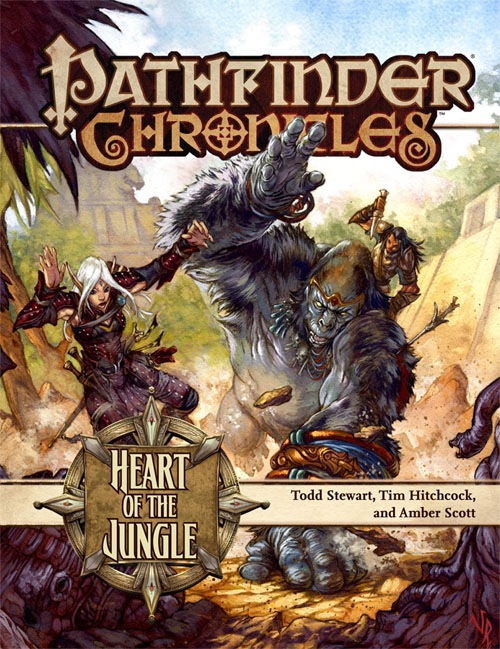
Paizo does have an adventure set in the Mwangi Expanse.  Here it is:

The adventure is designed around an awakened Gorilla and a Gorilla God.  However, all the major human actors are white.  Okay, so it's not a good example.  

What about a D&D campaign that doesn't carry the Sexism against women?  How about a campaign set in a Matriarchy?  Although it will satisfy a lot of women who complain about sexism in D&D, a Matriarchy culture exists only in a few remote centers of the world.  And everything is backwards.  Well, almost everything.  The women rule, and the cultures are generally seen as more egalitarian.  Again, a product Wizards of the Coast won't consider releasing.  A Matriarchal campaign, with a perfect or ideal Matriarchy at it's center, will have to be produced outside both Paizo and Wizards of the Coast.

How about Homosexual gamers?  Why not try to cater to them?  Even though D&D books are filled to the brim with Beefcake (even the Sorcerer, Hennet, looked like he could take on Redgar), focusing around homosexual gamers can be problematic.  What do they want to see to make them feel better?  Yaoi -- which is depictions of light-hearted homosexual relationships, or Guro -- which is much more grittier and can include male on male rape.

First of all, there are marking problems with both of these.  Yaoi, which is lighthearted, is aimed primarily at young women.  You can typically get beautiful men kissing each other and having a fulfilling relationship.  You put this into a D&D book, and you get some confused customers.  They want scenes of adventure, and not two men kissing each other and having a deep relationship with each other in order to fulfill a woman's fantasy.  So, that leaves Guro, where you have more realistic, more mature homosexual relationships depicted.  Really, from a marketing standpoint, do you really want to sell D&D books with this sort of imagery inside them?

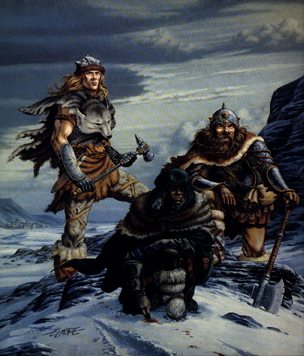
D&D sells better with images like this:


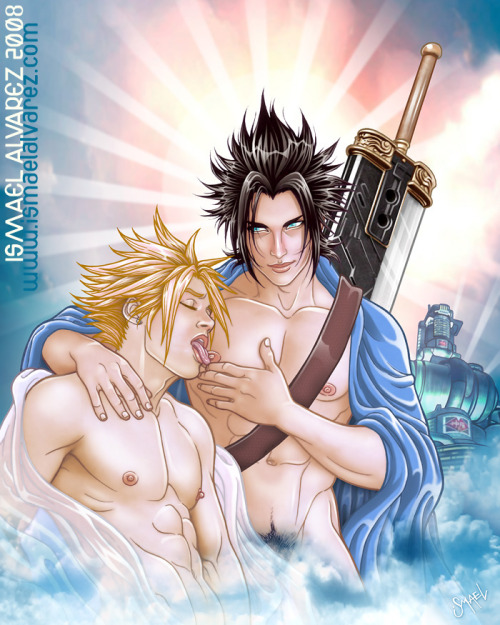
Not this:


But this is how to market D&D better to appeal to a wider audience?  What steps can we take to make women, black gamers, and homosexual gamers feel better?  Well, if you try to make D&D appeal to everyone, it won't sell, ever.  You are lumping everything in, and the end result is a mishmash that won't taste good and will probably not appeal to anyone.

However, the Black Gamer market is definitely worthy to cater to with the existing D&D books.  All Wizards of the Coast can do is create a Sub-Saharan Setting, make it Black gamer friendly, and market it.  Sub-saharan Africa doesn't have to be a niche product, it can be a core product.  And even white gamers would buy a product if: the number of white actors in art is kept down to a minimum -- or even taken out entirely.  Wizards of the Coast can enlarge it's customer base if it does the demographic research among black gamers and white gamers.  Check to see if caucasian customers would buy such a product, and produce it and market it for 5th Edition.  I bet the customer base would increase.

Now about those that scream Sexism in D&D.  First of all realize that it's not only women who are discriminated against in the new Dungeon Punk style -- men are also.  Wayne Reynolds draws men with in human musculatures -- i.e. BEEFCAKE.  The style is so inhuman that his men look not in proportion.  Every time I look at one of Wayne Renolds' men, I have a dissonance disconnect.  Then there is CHEESECAKE in D&D, and it's over emphasized with the Dungeon Punk style, thats true.  But in Second Edition D&D, there is always good examples of women who aren't always there as eye candy.

So, instead of making a niche product that is based on the idealistic matriarchy (and that's putting it over the top), how about hiring a more varied artist base?  By having a varied artist base, you can't always guarantee that cheesecake will go away; but you will get less sorceresses in loin cloths and more women in full armor, or full dresses, or fully clothed. 

Finally, there is Homosexual Men.  If homosexual gamers are into yaoi and are more pleased by yaoi stories, they wouldn't be gaming in Dungeons and Dragons.  Homosexuals into yaoi are looking for something different.  They want deep character stories where the boys share their love at the end, than going into Dungeons and beating up on goblins.  That leaves Guro imagery. However, Dirk Benedict made the call that if the A-Team would be produced today, it would be called "the Gay Team."

So, to appeal to the Homosexual gamer, you need more pictures of male camaraderie. You don't need to dip into Guro -- where you get homosexual sex, sometimes of a rape nature.  And you don't need to dip into yaoi, which depends on deepened Character stories and caters more to young women than to homosexual gamers and aren't representative of D&D at all.

Of the three, to appeal to a wider audience, WotC just needs to do three things:

1. Produce a setting based on Sub-saharan Africa and leaving out caucasian genotypes or representing them at a bare minimum and have African genotype characters represented in the art overwhelmingly.

2. Take a more moderate approach to Art and in how men and women are depicted in the D&D books.  Less beefcake and cheesecake, and more realism.

3. Do not do yaoi, yuri, or guro, but put more pictures of an all male team in your books.  Or a team made up of tomboys so as to go for the gay and lesbian demographics.

4. finally, as to the last two, moderation is the key.  Sure, we want to see varied teams, but remember there are those that feel comfortable with a team of men being comrades, and those that are comfortable to see a team of tomboys try to make it in their world.

That's pretty much all that I have to say about it.  However, for those calling for change -- and to Sarah Darkmagic in particular, you have to realize that tons of market research went into D&D.  To get what you want, you also have to realize that market research has to be done.  To prompt such market research, go to GENCON and make yourselves heard.  Tell all your gamer friends to attend GenCon this year (if possible) and show the WotC representatives that people of all kinds play D&D.  Attend the RPGAs, hold games of your own, do everything you can to show that D&D has one true demographic -- the Creative, Scholarly, and Intelligent who want to play games catered to them besides Chess and Checkers.

Sunday, November 6, 2011

Myth and Roleplaying

Once there was a hero . . .

Who took up arms . . . .

To save the beautiful princess . . .

From the Dragon.


Thus begins the discussion in the video: "Remembering the End of the World."  The video talks about a dozen or so Archetypes that exist in human myth: the Hero, the Princess, the Dragon, the Great and Wise King.

When gamers roleplay, they are taking on the roles of the mythic Archetypes in order to defeat monsters of Chaos -- both real and imagined.


Black Dragon by *BenWootten on deviantART

To say the least, we role-players which to relive the mythic archetypes.  In a strong way, we are re-enacting the stories and the legends of the ancient Mythmakers.  We are the Hero in the story, off to fight powerful chaos monsters such as the Dragon, or the Chimaera, or the Gorgon.  Especially with her long, disheveled hair of snakes.   We act the part of Perseus, Hercules, Achilles, Theseus, even Arthur and Saint George.


We relive these Archetypes.  But where do they come from?  Carl Jung however said that they were deep archetypes, a part of the human psyche that was in borne that couldn't go away.  However comparative Mythologist David Talbot has other ideas.

What if the Hero in the story was actually a planet?  The planet Mars.


In Roman Mythology, Mars was the God of War and Agriculture.  Unlike modern representations of Ares -- as an Evil god who wanted perpetual war and conflict; Mars was was a hero god -- who saved the Princess from the Dragon.


Mars was the prototypical hero.  As for the Princess -- what if she was also a planet?  The planet Venus.  But that still doesn't explain the Chaos Monster or the Good and Wise King.  Let us reveal these archetypes for what they are: a planet and a comet.  The Good and Wise King, the archetype for all kings here on Earth, is a planet.  The planet Saturn.

The Chaos Monster, the Dragon -- a monster who has remained in man's imagination for a very long time -- is a creature that has no basis in the biological world.  Part serpent, part bird, part tiger, part leopard -- the dragon is the combination of all life.  But it has long flowing hair and is associated with Lightning.


To be fair, the Dragon or Chaos Monster is a comet.  A comet of planetary size and proportion . . . once again, the planet Venus.   How can the Planet Venus be both the beautiful Princess and the Chaos Monster?  In ancient times, the Mother Goddess was also the Goddess of Death and Misfortune.  In India, Khali is or was worshipped as the Goddess of Life and Death.  The same is true of Aphrodite, who is the Goddess of Love and Death in Greek Mythology.  According to the Egyptians, the planet Venus is associated with the Goddess Hathor -- who could turn into the terrible lioness Sekhmet.  And the planet Venus is also associated with Isis, the queen of the Gods.

And as for Saturn as the wise and good king of Heaven?  In a revelation to Abraham about the stars and the planets Yahweh (Jehovah) revealed: "These are the governing ones; and the name of the great one is aKolob, because it is near unto me, for I am the Lord thy God: I have set this one to govern all those which belong to the same order as that upon which thou standest."


--- Abraham chapter 3, verse 3. 


Most Mormons, who have this revelation, believe that the star Kolob is in the Center of the Universe, or the Center of the Galaxy.   However, this tradition is wrong and in error.  Kolob is a planet.  The planet Saturn.  


The word kolob is related to the word qelb, an Arabic word that means to turn around -- to rotate.  According to Yahweh, the planet Saturn was meant to be the lesser light (yes, Genesis says it was the moon).  The star which was the nearest unto God's throne.   It was to be used according to the times and seasons, as one revolution of Saturn's poles was to be as a day unto Yahweh -- one thousand years according to our reckoning here on Earth.  In ancient times, Saturn was worshiped by astronomers who were heathens.


Saturn became Osiris to the Egyptians, Saturn to the Romans, Chronus to the Greeks, Huang-di to the Chinese, and Brahma to the Hindus.  As the unmovable first sun, Saturn became the prototype for all kings on Earth.  The good and wise king, who brought prosperity during Man's golden age -- the Garden and the Time of Perfect Virtue. 

These are the archetypes that satisfy Roleplaying, but lets focus on the Dragon for a moment.

I'm interested in Astronomy and Mythology on how they relate.  When David Talbot talked about the Dragon being a monster that has no place in nature, it clicked when he said that the dragon was a comet.  In China, comets are seen as good luck.  However, in Europe, comets were seen as things of dread.  They are both these things.


I wanted to model my own dragon, my own representation of the comet Chaos Beast.  Although I have the DAZ Eastern Dragon and can use it at any time, modeling my own would be a challenge.  I thought I would base it on the paintings of this man in Nikko.  He draws the dragon with only two arms and a long sinewy tail.  How to accomplish this feat?

By using Pixologic's Z-Brush.  Z-brush allows one to sculpt completely in 3D with an orb of modeling clay made out of energy.  The program works in billions of polygons, allowing one to sculpt in fine detail.  After the initial sculpture is complete, I can paint it (texture it).  Afterword, one can export it to DAZ Studio 4 Pro and use the figure setup tools to set the dragon up and articulate it.  After this is done, I can then save it in DAZ Studio (with DS presets) in order to prepare the model for sale in the Renderosity Marketplace (DAZ Studio only, however enterprising people should be able to set it up for Poser).  Along with it's Maya and Vue counterparts.

The idea is to prepare a creature that represents a comet, seen in the sky.  Although uniformatarists scoff at the idea of Cataclysm or Catastrophe -- these are what the archetypes represent.  They represent stories of Catastrophe from days gone by.

Tuesday, September 6, 2011

Technological Revolutions of the Age of Leo

Although I discuss the technology of the Stone Age, there are a couple of technologies from that time that are worth noting. Especially the Agricultural and Domestication revolutions, and the wheel!

Domestication -- was it God or was it You-Know-What?

Scientists say that the Agricultural Revolution occured in the Middle East and then spread to Europe.  The problems with wild cereals and our domestic cereals are often brought up in Television programs about that time in History.  Most notably, Stories from the Stone Age.  How did we get from wild cereals to domesticated wheat and barley?
Corn.  Where is it's ancestral grass?

Simply, we are the victims of a shell game if we are led to believe that humans did a process of selection with the gardens and wheat fields they planted and we somehow got domesticated varieties from their wild predecessors.  What is worse that corn, or maize, ancestral plant has never been located.  And maize depends entirely on humans in order to grow.  This is a scientific fact.  Every botantist knows that maize is a cultigen -- a domesticated species entirely dependent on humans to grow and flourish.

Our scientists have not been able to find the wild variety of maize.  So how can this be if the Agricultural Revolution took place in the Age of Leo? After all, maize is a form of wild grass, much like it's cousins.  So there isn't a good reason why it's ancestral wild grass is extinct.

The second hole in the puzzle of plant domestication is that we haven't been able to produce another cereal grain from wild grass in the whole history of the world!  Maslin and mullet not withstanding.  So, the question is, how did our ancestors perform such a feat?  Sources say that Cain was a farmer, but how and where did the first and second generation of Adam's seed ever get these cereal crops and where did they come from if they had no prior experience with genetics?  And even if you believe that Adam is a superstitious myth, where did a bunch of Natufians ever get their domestic cereal crops from wild grasses?

You-know-what has to come in the picture somehow.  You can't think that the Natufians ever lacked experience in plant breeding.  They had to have figured it out.  They had to have genetically engineer the grasses if you ignore all the other possibilities.  After all, wild wheat and barley have 7 chromosomes, and this increased to 42 in their domestic varieties -- their genetic code increased by a factor of 6!  Sugar Cane, another grass, had only 10 chromosomes.  But the domesticated variety has it's chromosomal count increased to 80.  This is a factor of 8!  What is going on here?  How did the Natufians ever figure out genetics if they are unsophisticated?  It had to be genetic engineering or the other -- who is regarded as superstition by many scientists.

Animal Domestication

How did we get a dairy cow from this?
How did we get a dog from a wolf?  How did we get a dairy cow from a wild aurochs?  Why are these two animals bred from aggressive stock -- one still living the other made extinct?   After all, a bunch of Natufians are still going to get a wolf if they raise a baby wolf.  And the Europeans are still going to get an aurochs if they raise a baby aurochs.

You have to change whole groups of genes to get Canis lupis familaris from Canis lupis.  Similarly, you have to do the same to get Bos taurus from Bos primigenius primigenius. So how did they accomplish it?  And why are we insulting our intelligence by assuming that the Natufians and the Europeans back in the New Stone Age were a bunch of people that accomplished this by crossbreeding?  You-know-what had to have been accomplished by Natufians and Europeans to produce the docile dairy cow and the familiar dog.


The Wheel
I touched on the wheel beforehand.  So I said it before, and I'll say it again.  The wheel was not invented by the Sumerians!  The Wheel came from the Neolithic Age, not the Sumerians.  Why?  Because there are etheric wheels in cave and primitive art everywhere.  We are fools to ignore the fact that ancient human testimony called for a planetary constellation in our Northern Sky.  All simple machines are pretty easy to figure out from Earth geography.  Except the wheel. 


In ancient times, the Age of Leo was known as the First Time by the Egyptians. A time when three planets were in a great constellation in our Northern Sky.  The Artists did not get their inspiration of the wheel from the nature all around them.  all they had to do was look up.  The artisans only had to look up.

In an inspired act of art imitates nature, Artisans made the wheel after looking up and imitating what they saw by carving wood or stone.  Disbelievers may scoff and say that humans invented the wheel by saying they saw a bone twirl in the air.  This is nonsense, a modern myth inspired by the movie 2001: A Space Odyssey and the same book by Arthur C. Clark.  Arthur C. Clark never did see the ancient cave art of the neolithic times, nor did he come to the conclusion that there was three planets in our sky in a great constellation.  The Wheel was invented during the Age of Leo and not by the Sumerians (who are the descendants of Elam).

Thursday, August 11, 2011

Phoenicia Player's Guide in Layout! plus FAQ

Yes that's right, the Phoenicia player's guide is now in layout!  One of the interesting things about this player's guide is that there isn't going to be an image of the city with it's falls.  The problem is: No one in their right mind has built a thriving city around a waterfall yet, especially one as big as a cataract fall complex.

The cataract waterfall is actually inspired by Iguazu Falls in both Argentina and Brazil.  Although Mosi-oa-Tunya ("The Smoke that Thunders"), also known as Victoria Falls, is also an inspiration. 


Why would a thriving city be built around a cataract?   Well, people do dumb things.  But the major reason is the Lemurian Obsidian pyramid located under the major spill way.  Made of Orgonite, the pyramid attracts both Arcane Spellcasters and psions.  Fortunately, the psions got there first and started to build a magnificent city.  However, in real life, the practical problems of flooding and noise pollution (from the falls) are practically tough to overcome.  So, city builders had too many problems with cities centralized around waterfalls.

Q. Why a city of Psionics in Pathfinder?

A. Everyone needs a city that they can drop in their campaigns without a fuss.  Phoenicia, and it's three sister cities -- Sybaris and Syracuse; are designed so that the Game Master can do just that.  This allows you to explore psionics at your leisure if your players or you -- the GM -- enjoys the system.

Q.  Why don't you just add it to Glorion?
 
A. Are you nuts?  No Author in his right mind would submit his work to Paizo and sign a work for hire agreement when the Internet -- the world's most powerful and easiest Copying Machine -- is still operational.  I'll take my chances with releasing it under the Creative Commons Attribution-Share Alike 3.0 License.

Q. Why a Creative Commons License?

A. Why not?  With a creative commons license, major companies can compete with me directly.  So everyone wins.

Wizards of the Coast wins, because they can create a game book derivative of mine.

Paizo wins because they can do the same.

Same for Dreamscarred Press.

Steve Jackson Games.

And a host of other companies.   Plus, the city can reach an amazing amount of gamers.  So I win, and you win.  You can get an official 4e product and play Phoenicia with official 4e guidelines.  Or you can get an official Exalted product and play Phoenicia with Exalted.  Plus, gamers can translate it into their favorite languages and the translations can compete with each other.  Again.  Everyone wins.

Q. Are you nuts?

A.  No, I am not.  But please, don't flood my email box asking for permission, I'll get frustrated with you all.

Saturday, July 30, 2011

Character du Jour: Alarcawen, elocater


Sometimes, a psion Nomad and a Fighter can go together to make an interesting combination.  The Elocater prestige class in the Expanded Psionics Handbook (now Psionics Unleashed!) is meant to combine fighter and psion, or just a plain psychic warrior, in tandem.  Alarcawen, which means "Swift/Rapid Girl" in Quenya (thank you, good Professor) is an apt athlete who has learned the arts of fighting with a sword.  She is based on Wayne Reynolds' illustration of a Dromite Elocater. 

Alarcawen is a psion first, warrior second.  She was always fast when she ran through the forested meadows of her home in Massalia.  It was rumored that no one boy, elf or otherwise, could surpass her speed while she was in childhood.  When it was time for her to study, she chose to be a psion rather than monk or a rogue.  She still learned how to fight with a longsword, and she became quite proficient in it.

During the Elf Troll wars in which the elves battled the trolls while some of them looked for a new home to settle in, she excelled in combat.  Pretty soon, she learned how to combine the might of a Nomad (a psion who specialized in psychoportation) with that of a fighter.  This attracted the attention of the Elocaters of Massalia, which were a very small group.  They've been watching the elf girl since she was a child, and now they took the girl under their wing and taught them their secrets.  She now scorns the Earth and does battle against her enemies using a combination of speed and mental alacrity.

She came to Phoenicia, the City of Psionics in order to root out her enemies.  The Dark Brotherhood, a society of assassins, had slain most of her living family and now she wants justice.  But sometimes, justice takes the form of vengeance when the Law can do nothing to bring the perpetrators to justice.

Alacawen   CR 10
XP 6,400
Female Massalian Elf Psion 3/Fighter 3/Elocater 3
NG Medium Humanoid (Elf)
Init +4; Senses Low Light Vision; Perception +11

DEFENSE
AC 18 (22) Touch 15, Flat Footed 17 (+4 Dex, +2 Floating Leather Armor, +4 Inertial Armor, +1 amulet, +1 ring)
hp  61 (3d6+3d10+3d8+18 con)
Fort +7, Ref +8, Will +8; +10 against enchantment spells and effects; +9 against Fear
Defensive Abilities Armor Training, Bravery, detect psionics

OFFENSE
Speed 40 ft.
Melee "Langoril" (+1 Sundering Longsword) +7 (1d8+1/20/x2) or +2 Daggers of Teleporting +12 (1d4+2/20/x2)
Ranged +2 Daggers of Teleporting +8 (1d4+2/20/x2)
Psionic Powers Known (Discipline - Psychoportation, ML 5, Power Points 27)

Level 3 -- Astral Caravan, Psionic Blast, Telekinetic Force
Level 2 --  Dimension Swap, Dissolving Weapon, Ego Whip, Thought Shield
Level 1 -- Burst, Deceleration, Empathy, Inertial Armor, Teleport Auxillary (hyp)

STATISTICS
Abilities Str 12, Dex 19, Con 14, Int 17, Wis 14, Cha 15
Base Attack: +6  CMB +10  CMD 11
Feats: Agile Manuevers, Dodge, Expanded Knowledge, Mobility, Psionic Dodge,  Psionic Talent, Spring Attack, Weapon Finesse
Skills: Autohypnosis +9, Fly +14, Acrobatics +8, Climb +4, Handle Animal (horse) +5, Knowledge (Dungeoneering) +9, Knowledge (Psionics) +13, Ride (horse) +7, Perception +11, Spellcraft +13, Swim +2
Languages: Common, Elvish, Massalian Elvish, Orc
SQ: Elven traits, eternal grudge (Arcadian Elves), aerial acrobatics, armor training, dimensional step, discipline (psychoportation), Discipline Talents (Burst, Deceleration), freerunning, personal gravity, scorn earth, spatial awareness, terminal velocity

Combat Gear: Langoril (+1 Sundering Longsword), 4 Daggers of Teleporting (+2), Floating Leather Armor (+1); Other Gear: amulet of natural armor +1, cloak of resistance +1, ring of protection +1, 200 gp

SPECIAL ABILITIES
Aerial Acrobatics
The elocater adds her ranks in Acrobatics as a bonus to any Fly checks, and her ranks in Fly as a bonus to any Acrobatics checks, due to her ability to control her personal gravity. She also treats all Acrobatics checks to jump as if she had a running start.

Dimension Step
An elocater of 3rd level or higher can slip psionically between spaces as if using the fold space power, once per day. The elocater cannot bring any other creatures with her. Her manifester level for this effect is equal to her elocater level. At 6th level, the elocater gains a second daily usage, and at 9th level, she can use this ability three times per day. 

Freerunning
Beginning at 2nd level, an elocater's land speed increases by 10 feet. This is treated as a circumstance bonus (it does not stack with terrain-based circumstance bonuses, such as the circumstance bonus from using skate on a decline). This bonus increases to 20 feet at 5th level and to 30 feet at 8th level

Personal Gravity
As long as the elocater is within 1 foot of a sufficiently stable solid or liquid surface, she can change her personal gravity with a thought (free action). As a result, she may move on walls, ceilings, etc. as if they were level floors, including being able to run, jump, and take 5' steps.

Personal gravity is constantly active, even when unconscious, unless the elocater deliberately suppresses it (a free action), is heavily encumbered, or is slain. If the elocater is carrying a medium load or wearing heavy or medium armor while using personal gravity, her speed reduces to 10 feet per round.

Scorn Earth
At 1st level, an elocater’s feet lift from the ground. From now on, she can float a foot above the ground, but still move and act as if she were standing on solid ground. At distances greater than 1 foot from any sufficiently stable surface, her speed diminishes to 10 feet per round, but she can move in any direction (including straight up or down). Melee and ranged attacks suffer increasing penalties as if she were the subject of the defy gravity power.

Scorn earth is constantly active, even when unconscious, unless the elocater deliberately suppresses it (a free action), is heavily encumbered, or is slain. If the elocater is carrying a medium load or wearing heavy or medium armor while using scorn earth, her speed reduces to 10 feet per round.

Spatial Awareness
Beginning at 2nd level, an elocater's hyperawareness of spatial relations lets her use the battlefield to her advantage. When she attacks with a bonus from higher ground or is flanking the attacked enemy with an ally, the first attack she makes against that enemy each round gains a +2 insight bonus to her attack roll and damage roll (if the attack hits). Furthermore, due to her ability to reorient herself, enemies no longer gain a bonus when attacking her from higher ground. At 5th level the insight bonus increases to +4, and at 8th level the insight bonus increases to +6.

Terminal Velocity
As long as either personal gravity or scorn earth is active, if the elocater would be in a position to fall (for example, stepping over a pit), she instead hovers at her current position, as if standing on solid ground. As a move action, she can safely float or jump down 30' (she can float down an additional 30' per additional move action spent in this way).  
  

Tuesday, July 26, 2011

Orgonite for your Dungeons and Dragons Campaigns

By Terry H (Flickr)
Orgonite is a compound that is easy to make by anyone.  It is proven to change negative energy into positive energy -- proven by layman experience.  The compound does this continuously all the time, without electricity.

In the real world, Orgonite actually exists and actually has these properties.  It it made of 50% metal and resin and has a crystal embedded in the center.  The substance is used to bust the nuts off cellphone towers, electric generators, and more by changing the frequency of the energy produced to a more life giving frequency.  It's not a joke and it's not a game.  It's actually based on scientific research.  However, thanks how the original researcher of Orgone was treated, it can't be properly explained by physics scientists or engineers as to how orgonite actually works.

ORGONITE IN THE PATHFINDER AND DUNGEONS AND DRAGONS GAME (3.5 EDITION)

Orgonite in the D&D game has psionic and magical applications.  Since the compound is used in simple energy conversion, it can be created by alchemists for use in the Wizardring World and the Psionic World.  In the typical Medieval Society, Orgonite is regarded by the superstitious as something that belongs to the Wise (Witches and Wizards) and will typically avoid the stuff on the advice of their parish priest or local cleric.

In a principality or country of Psionics, the people are generally more enlightened (about Renaissance or Age of Reason level) and it is produced more.  Orgonite has the same properties if used by a psion or a wizard, it's the only substance that transcends the Psionics Opaque barrier.  

[Begin Open Game Content]
However, it is incredibly easy to make (requiring a DC 12 Craft (Alchemy) check).  The materials needed are a double terminating quartz crystal, some pine tree sap or resin, an alchemical hardener (to turn the sap into amber), and fine metal filings.  The material in which the amber sets needs to be lightly treated with olive oil (except if paper is used for the mold).

A layman can use orgonite to ward off mental affecting spells that could potentially harm him.  An orgonite pendant will give him a +2 item bonus to his will saving throw against spells like Irresistible Dance, Confusion, and Insanity.  Unfortunately, an orgonite pendant can't tell the difference in how Charm Person, Charm Animal, and Charm Monster is used.  It actually amplifies the effect of Charm spells due to the energy being seen as positive, and gives the layman a -2 penalty against these sorts of spells.

Because of it's properties, Alchemists and Wizards with the Craft Rod item creation feat can use Orgonite to make Metamagic rods. Since orgonite can amplify positive energy, wizards simply need to magically attune the orgonite to amplify magic.  An Orgonite Rod can simply be attuned to one metamagic feat.

For a Psion, since Orgonite can awaken and amplify psionic energies, it can be used to make a metapsionic talisman.  A psion with the Craft Psionic Talisman feat just simply needs to make the orgonite talisman with the above materials and psionically attune it to a metapsionic feat.

CRAFT PSIONIC TALISMAN [Psionic Item Creation]

You can make psionic talismans.

Prerequisite: Manifester 9th.

Benefit: You can create psionic talismans. Crafting a psionic talisman takes 1 day for each 50 gp in its base price. To craft a talisman, you must use up raw materials (metal filings, pine tree resin, alchemical hardener, quartz crystal) costing a fraction of its base price.  Then you must spend a day attuning the talisman to a metapsionic feat or power that you know.


PSIONIC TALISMANS

Metapsionic, Burrowing (example)

Aura: Strong psionic, ML 17th

Slot: None; Price: 3,000 gp.; 11,000 gp (normal), 24,500 gp (greater); Weight: 3 ounces.

Description:  The holder can manifest up to three powers per day that are burrowing as per the metapsionic feat.

Construction:
Requirements: Craft Psionic Talisman, Burrowing Power; Cost: 1,500 gp (lesser, 50 gp for materials; rest for attunement); 5,500 gp (normal, 50 gp for materials, rest for attunement), 12,500 gp (50 for materials, rest for attunement).

[End Open Game Content]

OGL Section 15:

Orgonite for your Pathfinder and Dungeons and Dragons Campaigns, Copyright 2011 by Elton Robb.  Author: Elton Robb

Note: All items in this article known as "product identity" as defined by the Open Game License are under the Creative Commons Attribution-Share Alike 3.0 Unported License.

Monday, July 25, 2011

Psionics

DIFFERENT PSION SPECIALISTS

THIS WEEK -- THE EGOIST
Also known as: Martial Monks, psychic gymnasts, psychic healers, Goku rip-offs

House Redoran warrior, by yours truly
Egoists are psionic martial artists, concentrating their energies on their bodies.  They are psions who have high intrapersonal intelligences.  They are completely in tune with their bodies.  Because of this intuition, egoists are capable of manipulating their bodies with their will.   Egoists usually learn martial arts to augment their own combat abilities.  Although some have the ability to heal others.

Egoist Psionic Powers List

Level 1 --- Minor Metamorphosis, Natural Healing, Thicken Skin
Level 2 --- Animal Affinity, Chameleon, Empathic Transfer
Level 3 --- Ectoplasm Form, Hustle, Metamorphosis
Level 4 --- Psychic Drain
Level 5 --- Psionic Revivify, Psychofeedback, Restore Extremity
Level 6 --- Cleanse Spirit, Greater Metamorphosis
Level 7 --- Fission
Level 8 --- Fusion
Level 9 --- True Metamorphosis


Archtypes
HUMAN PSIONIC MARTIAL ARTIST
Class: Psion (Psychometabolism speciality)
Feat: Unarmed Martial Strike
Feat (Human): Psionic Fist
Feat (Psion): Up the Walls

ELVEN PSYCHIC HEALER
Class: Psion
Feat:  Psionic Talent
Feat (Psion): Psionic Meditation
Powers: Empathy, Natural Healing, Heal Light Wounds

Wednesday, July 20, 2011

Map of Phoenicia completed


Map of the land of Phoenicia by ~Atlantean6 on deviantART

A map of Phoenicia and the surrounding lands are complete.  I did it this morning, so enjoy.

Oh, you do need a Deviant Art account to see the whole thing -- and make sure you have mature settings set to on.

:D

Friday, July 8, 2011

New Noble House


The Dragon Folk by ~Atlantean6 on deviantART

This is the Noble House of Draco.  The house that tattoos it's members with the iconography of dragons. I'm thinking of adding them to Phoenicia.  Are they allies, or are they foes?  Only you can decide for sure.

Thursday, June 16, 2011

Orcs of Galatea

The Orcs of Galatea chapters are being consolidated at the moment.  I've been taking them and consolidating them so that they will be ready for publication sometime this summer. :)

I haven't done the cover art for it yet, but rest assured, it will be spectacular.  The entire book will be both covered by the Creative Commons License and the Open Game License.   With guidelines on which is covered by the Creative Commons License and which is covered by the Open Game License.

So that publishers of d20 media can pick and choose which they want to republish, and which they would like to make a derivative (just so long as they share too).

Wednesday, June 15, 2011

Chapter 9 of Pheonicia: the Docks

The Docks

In the Hellenic and Desert Quarters of Phoenicia is the docks of Phoenicia.  Five miles down river is the Sea, and the river here is wide enough and deep enough beyond the cateract to service seagoing ships.  A dozen ships moor here in the deep waters of the Sardis river at any given time.  Sometimes many more than a dozen. This is a particularly rough area of Phoenicia and includes the city's famous "red light" district.


Part of the Sardis Estuary, the docks are full of warehousing, shipyards, hostels, and taverns.  These establishments service the merchants and sailors who use them extensively.  Connected to the Old City on one side of the Sardis River and the Poor city on the other, the Docks district seems like its own separate community.  Of course, many residents of Phoenicia live out their lives without going there.

By Ángel Serrano Sánchez de León (Own work) [GFDL (www.gnu.org/copyleft/fdl.html), CC-BY-SA-3.0 (www.creativecommons.org/licenses/by-sa/3.0/) or CC-BY-SA-2.5-es (www.creativecommons.org/licenses/by-sa/2.5/es/deed.en)], via Wikimedia Commons
The Flavor of the Docks
The smell of fish and the river pretty much dominates here.  The sound of the falls can also be heard all the time, but the further one is away from it, the softer the sound is.  Also, depending one which side of the river you are on, the larger than life statues of Zeus (on the Hellenic side of the cateract) and Buddha (on the Vedic side of the cateract) carved into the escarpment dominate the skyline.  There are dozens of seagulls in the air, each of them trying to find food.  The wooden buildings of the docks is stained with grime, but not necessarily salt.   The district boasts few new buildings; with several old buildings that should be condemned and torn down.

The streets bustle from daybreak to midnight with sailors and all manner of folk that support the shipping industry.  Basically, dockworkers and shipwrights, carpenters and warehouse laborers, harlots and strumpets and innkeepers, and so on.  These are hardworking folks with rough demeanors living roughened lives. Most are looking for strong drink and entertainment when not working, especially sailors who are off the ships getting their land legs back.  The two sides are not a place for those who love to be offended or people who worry about little details.  It's really no coincidence that the Hellenic and Vedic Nobles live on top of the escarpment that is responsible for the cataract falls in the first place.  They are as far from the docks as anyone can get, both vertically and literally.

Many types of ships come into the harbor.  Zebecs, dhows, biremes, triremes, reed barges from fabled Khemet, galleys, galley barges, baghlahs, and other ships.  These ships carry passengers and cargo.  Cargo to trade, passengers to buy or sell or to settle and make a living.  Large ships often drop anchor in the river and rely on smaller ships to transfer their cargo.  However, this is rare and it is to avoid the daily user fees for docking.

The Docks were constructed on either side during the Vedic occupation of the site.  Which is why they are connected to the Old City in the Hellenic Quarter.   Since the conquest of the Hellenes, the docks on the Hellenic Quarter was razed as a matter of course, and was built according to the manner of the Hellenes.  The Vedic docks still retain their distinctive flavor.

by Raja Ravi Varma (1848-1906)
One the Hellene side, a temple to the god Poseidon dominates the merchant roads of this district.  While on the Desert side a temple to Varuna was constructed.  That temple had fallen into disrepair.  The temple to Varuna was eventually demolished and a temple was built to the Desert Elves' One God, forcing Hinduism to retreat from the Docks.  Despite this, though, Middle Kingdom immigrants built a small Taoist shrine in the Docks to take advantage of the Feng Shui of the region.

(end of Part 1)

Friday, June 3, 2011

The NPC Races of Phoenicia

The following races are typically reserved only for NPCs in Phoenicia. Players who want to play one of these races should ask their DM for special permission.  For full details on these races, one should consult the Pathfinder Bestiary.

Aasimars

Aasimars are the result of a Celestial bloodline mixed with a human one.  Although following this logic, all humans are aasimars, the Celestial bloodline is often made stronger by a Celestial becoming mortal enough.  Aasimars who are recognized as Aasimars command respect and awe.  Most aasimars often reinforce their reputations by committing acts of Benevolence and Heroism.  And it is said that some of Humanity's greatest heroes are Aasimars.   Virtually all aasimars are good aligned.  They typically are spread out among the population and may be as much a beggar as they are a noble.

Drow (Dark Elves)

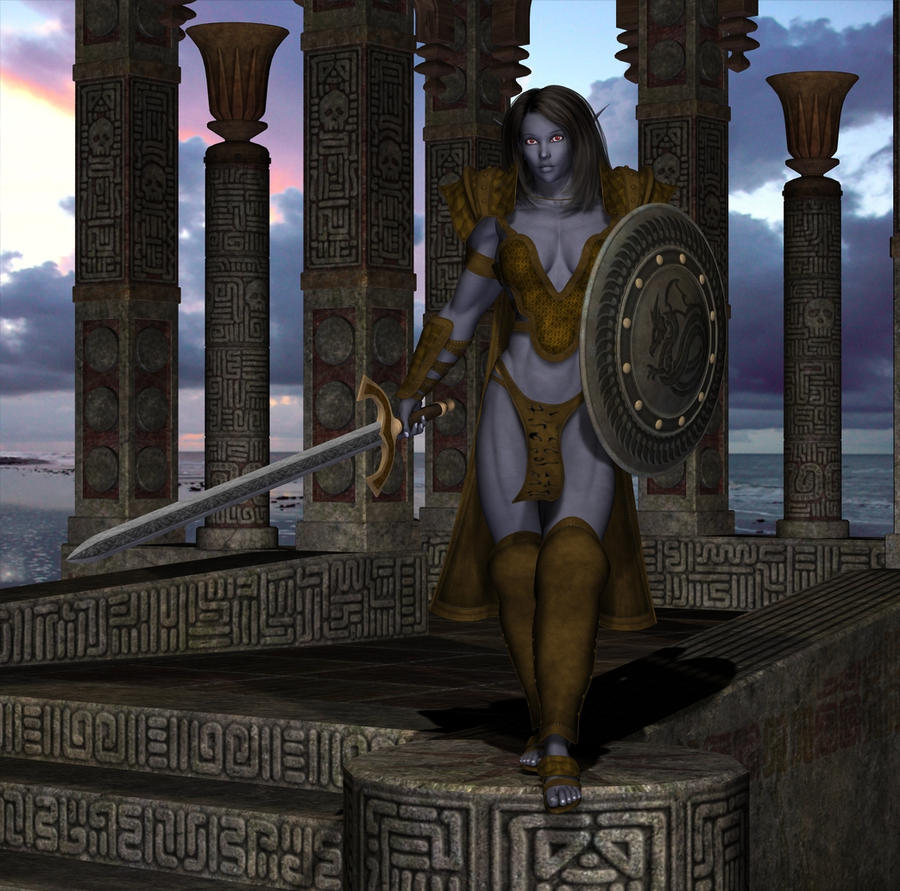
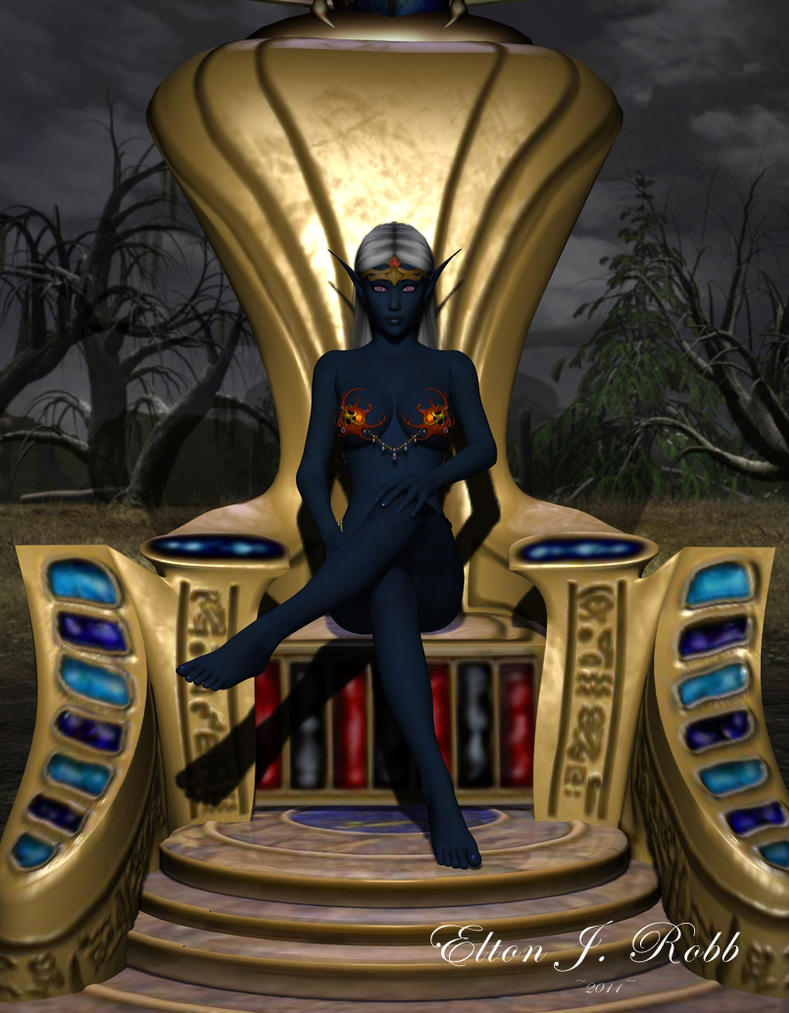
By myself, of course

The Fifth elvish race are known as the Drow (pronounced Drau as in "cow") most everywhere except in the Hordelands and parts of the Northlands where they are known as the svartálfar (or black elves).   They have a reputation for being evil, wicked, and fiendish.  Their culture, although extremely individualistic and clannish, is in opposition to human and elven culture.  They have a reputation of being crafty, duplicitous, and nasty.  It is said that they value deception and guile and scoff at honesty. There were times in the past when these fears were confirmed when two drow armies tried to invade Phoenicia before the Hellenes conquered the city.

They succeeded once, but were driven back and destroyed and they never succeeded again.  Phoenicia under the rule of the dark elves was a place of near anarchy; except when the dark elves at the time laid a heavy hand.  Whether or not dark elves now are virtuous or kind its not up to debate.   There is a law that has been in place before the Hellenic Occupation that if any dark elf is discovered then they are to be arrested and imprisoned or executed without trial.

Deep in Phoenicia I, the Dark Elf Madame Ssapinitra Kennett maintains a haven for her kind.  So far, it's secret and no one knows how deep it is.


Half-Dragons

Half dragons are the result of unions or magical experimentation between a humanoid and a dragon.  Dragons typically live a long time, and young dragons have been known to dally with "mortals" (humanoids) or most anything.  Or, crazy wizards may do breeding experiments to produce a particular monstrous result.  What ever the case, half-dragons have been known to be the result.

Half-dragons of a humanoid nature in Phoenicia usually come from Silver Dragon, Red Dragon, or Gold Dragon stock.  While silver dragons are the friendliest and gold dragons are often caught up with humanoids, Red Dragons have been known to play with their food if it's intelligent (or sometimes even fall in love with them).

Half dragons are both respected and feared.  They are rare and tend to be more humanoid than not.  The humanoid types, though, form small communities in the poor sector and call themselves the "Dragonborn" in response to racism.  Generally though, the population is law abiding despite any tendencies individuals have towards committing evil.


Orcs

Orcs are beyond the Dragonwall and come from the Hordelands.  Although exceptions such as the Desert Viper Clan exists, most orcs live in the Hordelands and typically do not bother anyone in Phoenicia.  Orc Myth say that they were born of a forgotten orc god -- which they call the Creator or Nwali.  Nwali, however, is not worshipped and the orcs revere their ancestors or practice animal reverence (through Heathen Shamanism).

Although there is no question that the Orcs brought a codified demon magic through Warlocks into the world; the orcs are generally honorable if slightly antagonistic towards humans.  Although a full scale war between humans and orcs was committed years ago, racial tension is there and every once in a while war erupts between the two races somewhere on the planet.

Generally, the relationship between Phoenicia and the Desert Viper clan is cool.   Every once in a while the orcs raid the city.  The city has never been conquered and it has never been destroyed by orcs.  But no quarter of the city has not felt the orc torch.


Tieflings

If aasimar exists, so do tieflings.  Tieflings are the result of infernal blood being mixed in to human(oid) bloodlines.   A tiefling is typically the descendant of a human-infernal union -- either through a succubus/human mating or a horned demon/human mating.  Tieflings of elven and orc stock are typically called something else.  Tieflings are either warriors, spellcasters (of these, they are typically Warlocks), rogues, or clerics of evil gods.  Most tieflings are evil, and some are chaotic.  It is rumored that one noble family is all tieflings.

Monday, May 30, 2011

The Races of Phoenicia -- Major Races

The races of the population of Phoenicia are in many ways standard to the races found in the Pathfinder Core.  However, there are a few aspects that are unique to each race that tailor them to the setting.  Also, a few new races and a few "monsters" can also make acceptable PC races. 

Pathfinder Gamemasters and Dungeons and Dragons DMs should decide which races they should allow in their version of Phoenicia.  For your convenience, this post goes into more detail about the races in the player's primer.  They are still divided into Major Races, Minor Races, and NPC races.  The latter are races found in the City of Psionics that are not appropriate for play without consideration on the GM's or DM's part. 

As always, information in the Pathfinder Core Rulebook as well as information in the various Dungeons and Dragons core rule books, should take precedent unless information here contradicts them.   You should also consult the Player's Primer.

Major Races

The major races of Phoenicia are those found in the Pathfinder Core Rulebook, and the Dungeons and Dragons Player's Handbook.  For the Phoenicia setting, they require some changes.   In theory, you -- the GM -- should allow all of these races in your Phoenicia campaign.


DWARVES

The Dwarves come from another world, but were made up of six different tribes.  The Pale Ones, the Gold Ones, the Iron Ones, the Wild Ones, the Dark Ones, and the Desert Ones.  The Pale Ones migrated to the extreme North East, looking for a way to live their isolated, seal hunting ways.  The Pale Ones eventually became the Snowdown Clan.  The Wild Ones migrated into the extreme south of Vedan Lands and became known as the Jungle Dwarves.  The Gold Ones migrated into the extreme southwest, going beyond the fabled land of Khem and beyond human exploration.  This left the Desert Ones, the Dark Ones, and the Iron Ones.

The three of them maintained what little contact they had and formed a tri-clanship.  The Desert Ones became the Wildstone Clan, the Iron ones became the Ironhammer Clan, and the Dark Ones became the Vulcan Clan.  The Clans then split up.  The Wildstone Clan found rich copper ore deposits to the east and settled in the southern hills and valleys of the Dragonwall Mountains.  They would eventually teach Mankind how to make bronze swords with a stone mold.

The Ironhammer Clan moved into the North and West of the Dragonwall, finding rich iron deposits and eventually mastering the Riddle of Steel.  The Ironhammer Clan became a white and delightsome people, though unfortunately they learned the recipe of beer brewing from the fabled Khemites.  They eventually perfected the making of beer into a variety of ales, lagers, and beers (some with impressive heads).  People often wonder if the Ironhammers are just either making steel or getting drunk.  Those assumptions aren't true, of course.  Only a small percentage of Ironhammer dwarves really touch any sort of alcoholic drink.

The Vulcan Clan moved to an active volcanic island and colonized the island.  The Island, said to be the Forge of Hephaestus, became the home of the Vulcan Clan of Dwarves.  Their skins, a dark gray, was as suited to the hot environment they tunneled into as everywhere else.  The Vulcan Clan constructed a great fortress over the lava lake in the mouth of the volcano, and constructed a small city in the mountain itself.  However, living on an active volcano is one thing; and living in one is quite another.  Still, they mastered the art of forging ferroplasm, probably due to the high incidence of psionic talent among them.

Both of the Ironhammer Clan and the Wildstone clan uses the regular Dwarf creation rules found in the Patfinder Core Rulebook.  Wildstone Dwarf PCs, however, may select the Desert Runner elf trait in lieu of one of the regular Dwarf traits.

The Vulcan clan of Dwarves use the Duergar character creation guidelines in Psionics Unleashed.


ELVES

The Elves of Phoenicia come from five tribes that crossed from their world.  The five tribes include the Pelasgiri elves -- who were led by the Pelagsus dynasty; the Fair Elves, the Sea Elves, the Desert Elves, and the Drow.  However, splitting of the tribes have happened numerous times.  The Sea Elves settled and now live in the Great Sea, the nefarious Drow were mostly driven into caves, and the Desert Elves eke out an existence in the deserts and semi-arid areas of the land.  Their history will be described later.  As for the Pelasgiri and the Fair Elves ---

The Fair Elves and the Pelagsiri Elves lived beyond the Dragon Wall in what would become the domains of men.  The Fair Elves created the kingdom of Arcadia and the Pelagsiri split into dozens of barbarian tribes that lived in the central lands.

Pelagsus taught his barbarian people the secrets of making a rough garment, hunting, and basic agriculture -- although they were barbarians.  The Fair Elves, however, built a fledging civilization in Arcadia and started colonies throughout the World: Colonies such as Massalia, Syracuse, Tyr,  Asconia, and Verdania.   One such colony, Arcanus, traded with the Pelasgus elves of the Mountains above Arcadia.

However, the Pelagsiri became enamored with Fair Elf culture, and eventually became jealous when the Arcadians became petty and cruel in their eyes.  In the Middle Bronze Age, the Pelagsiri launched an invasion into Arcadia -- Elf slaying Elf and enslaving elf.

Using the Power of Storm of Vengeance and Waves of Vengeance, entire Arcadian cities were totally destroyed by fire or by sea.  Many Fair Elves were put to the sword or caught in chains.  In five short years, many strong Fair Elven populations were slaughtered and what was left was scattered to the five winds or enslaved.

The Pelagsiri conquered all of Arcadia and the land of Arcadia had become known as the Grey Realm.  Angered as to what happened, the Fair Elves in Massalia gathered together and it was agreed that invasion must be answered.  Building ships of war, the Massalians launched a naval war that caused a rift between the two Elf tribes forever.

While some cities, such as Asconia and Verdania, were eventually retaken; many Massalian Fleets were sunk in the depths of the Sea by the forces of the Pelagsiri's command of Magic -- which they inherited from the destruction of Arcadia.  The magnificent city of Tyr was eventually razed to the ground by Massalian elves after they couldn't retrieve specific texts from the Library of Magic.  Eventually, however, the war was one of a stalemate -- the Massalian Elves had to stop fighting the Pelagsiri Elves in order to preserve their economy.   And the Pelagsiri elves were left weakened.

However, without realizing it, the Massalian Elves got the last laugh as Man soon conquered and colonized Arcadia -- shrinking the Pelagsiri city holdings to just five cities.   The remaining Pelagsiri elves in Arcadia renamed themselves the High Elves, and their lands the Grey Kingdom after their Grey Queen.   And the Massalian Elves called themselves the Massalian Elves; although they hold that their nation is the only Fair Elf nation (which is untrue).

Eventually, slightly weakened, the Massalian nation was invaded by powerful feral trolls.  Faced again with the destruction of their culture, the Massalian elves had made pacts with demons for the power to drive the trolls out.  Once the pact was made, the Massalian Elves with their new found powers have pushed most of the trolls out of their borders.  Currently, several Eastern and Northern forests are in dispute.

As Man expands and form colonies, however, the Elven Range seems to be weakening.  Massalia is looking for new lands to start new colonies, so as to ensure that the Fair Elf race and culture can continue.

Both the Massalian Elves and the High Elves are created according to the Elf entry in the Pathfinder Core Rulebook.  In Dungeons and Dragons, the two groups are considered Eladrin.  However with some differences.

PCs belonging to both groups can choose to have blood feud with each other -- They may take Eternal Grudge, which is directed at one or the other.  The differences between the two are cosmetic.  Most Massalian Elves have eyes that glow brightly green or have emerald green eyes (others have brown, blue, or hazel eyes).   The High Elves have eyes that are blue, brown, grey, orange, or red.  The conflict between them is fifteen hundred years old, although both the Grey Queen and the Massalian Council are tired of the smouldering war.  Both elves are fair, although the Mediterranean Climate of the Massalia has given some of the Massalians a slight uniform tan.


GNOMES

Gnomes are the rarest of the Major Races, and typically live on the islands of the Great Sea.  The Gnomes are typically lovers of magic, music, and the sea.  They partake of the bounty of the sea, and generally are seen as dwarf elves (although most elves would deny the connection).  Some gnomish societies have dealings with the sea elves.


HALFLINGS

Halflings are so human looking that they are thought to be human crosses of either Ironhammer Dwarves or gnomes.  However, this isn't true as Halflings are their own race.  They frequently live among humans, but are seen as wanderers through most lands.  The Halflings avoid the Hordelands; though.   They don't find the term "Halfling" to be derogatory, but they do have a name for themselves in their own tongue which translates to "the People."


HUMANS

The humans are probably seen as children by the Dwarves and the Elves and other races.  However, if they were to know the humans' actual history on the planet, the Dwarves and the Elves will realize that they are the "younger" races.  The Human's range -- known as the World -- is slowly expanding.  However, as the real original race of the planet; humans have colonized virtually everywhere. No changes are needed to the humans from both Pathfinder and the Player's Handbook. 
Related Posts Plugin for WordPress, Blogger...