Showing posts with label Classic Play. Show all posts

Tuesday, September 6, 2011

Technological Revolutions of the Age of Leo

Although I discuss the technology of the Stone Age, there are a couple of technologies from that time that are worth noting. Especially the Agricultural and Domestication revolutions, and the wheel!

Domestication -- was it God or was it You-Know-What?

Scientists say that the Agricultural Revolution occured in the Middle East and then spread to Europe.  The problems with wild cereals and our domestic cereals are often brought up in Television programs about that time in History.  Most notably, Stories from the Stone Age.  How did we get from wild cereals to domesticated wheat and barley?
Corn.  Where is it's ancestral grass?

Simply, we are the victims of a shell game if we are led to believe that humans did a process of selection with the gardens and wheat fields they planted and we somehow got domesticated varieties from their wild predecessors.  What is worse that corn, or maize, ancestral plant has never been located.  And maize depends entirely on humans in order to grow.  This is a scientific fact.  Every botantist knows that maize is a cultigen -- a domesticated species entirely dependent on humans to grow and flourish.

Our scientists have not been able to find the wild variety of maize.  So how can this be if the Agricultural Revolution took place in the Age of Leo? After all, maize is a form of wild grass, much like it's cousins.  So there isn't a good reason why it's ancestral wild grass is extinct.

The second hole in the puzzle of plant domestication is that we haven't been able to produce another cereal grain from wild grass in the whole history of the world!  Maslin and mullet not withstanding.  So, the question is, how did our ancestors perform such a feat?  Sources say that Cain was a farmer, but how and where did the first and second generation of Adam's seed ever get these cereal crops and where did they come from if they had no prior experience with genetics?  And even if you believe that Adam is a superstitious myth, where did a bunch of Natufians ever get their domestic cereal crops from wild grasses?

You-know-what has to come in the picture somehow.  You can't think that the Natufians ever lacked experience in plant breeding.  They had to have figured it out.  They had to have genetically engineer the grasses if you ignore all the other possibilities.  After all, wild wheat and barley have 7 chromosomes, and this increased to 42 in their domestic varieties -- their genetic code increased by a factor of 6!  Sugar Cane, another grass, had only 10 chromosomes.  But the domesticated variety has it's chromosomal count increased to 80.  This is a factor of 8!  What is going on here?  How did the Natufians ever figure out genetics if they are unsophisticated?  It had to be genetic engineering or the other -- who is regarded as superstition by many scientists.

Animal Domestication

How did we get a dairy cow from this?
How did we get a dog from a wolf?  How did we get a dairy cow from a wild aurochs?  Why are these two animals bred from aggressive stock -- one still living the other made extinct?   After all, a bunch of Natufians are still going to get a wolf if they raise a baby wolf.  And the Europeans are still going to get an aurochs if they raise a baby aurochs.

You have to change whole groups of genes to get Canis lupis familaris from Canis lupis.  Similarly, you have to do the same to get Bos taurus from Bos primigenius primigenius. So how did they accomplish it?  And why are we insulting our intelligence by assuming that the Natufians and the Europeans back in the New Stone Age were a bunch of people that accomplished this by crossbreeding?  You-know-what had to have been accomplished by Natufians and Europeans to produce the docile dairy cow and the familiar dog.


The Wheel
I touched on the wheel beforehand.  So I said it before, and I'll say it again.  The wheel was not invented by the Sumerians!  The Wheel came from the Neolithic Age, not the Sumerians.  Why?  Because there are etheric wheels in cave and primitive art everywhere.  We are fools to ignore the fact that ancient human testimony called for a planetary constellation in our Northern Sky.  All simple machines are pretty easy to figure out from Earth geography.  Except the wheel. 


In ancient times, the Age of Leo was known as the First Time by the Egyptians. A time when three planets were in a great constellation in our Northern Sky.  The Artists did not get their inspiration of the wheel from the nature all around them.  all they had to do was look up.  The artisans only had to look up.

In an inspired act of art imitates nature, Artisans made the wheel after looking up and imitating what they saw by carving wood or stone.  Disbelievers may scoff and say that humans invented the wheel by saying they saw a bone twirl in the air.  This is nonsense, a modern myth inspired by the movie 2001: A Space Odyssey and the same book by Arthur C. Clark.  Arthur C. Clark never did see the ancient cave art of the neolithic times, nor did he come to the conclusion that there was three planets in our sky in a great constellation.  The Wheel was invented during the Age of Leo and not by the Sumerians (who are the descendants of Elam).

Saturday, July 30, 2011

Character du Jour: Alarcawen, elocater


Sometimes, a psion Nomad and a Fighter can go together to make an interesting combination.  The Elocater prestige class in the Expanded Psionics Handbook (now Psionics Unleashed!) is meant to combine fighter and psion, or just a plain psychic warrior, in tandem.  Alarcawen, which means "Swift/Rapid Girl" in Quenya (thank you, good Professor) is an apt athlete who has learned the arts of fighting with a sword.  She is based on Wayne Reynolds' illustration of a Dromite Elocater. 

Alarcawen is a psion first, warrior second.  She was always fast when she ran through the forested meadows of her home in Massalia.  It was rumored that no one boy, elf or otherwise, could surpass her speed while she was in childhood.  When it was time for her to study, she chose to be a psion rather than monk or a rogue.  She still learned how to fight with a longsword, and she became quite proficient in it.

During the Elf Troll wars in which the elves battled the trolls while some of them looked for a new home to settle in, she excelled in combat.  Pretty soon, she learned how to combine the might of a Nomad (a psion who specialized in psychoportation) with that of a fighter.  This attracted the attention of the Elocaters of Massalia, which were a very small group.  They've been watching the elf girl since she was a child, and now they took the girl under their wing and taught them their secrets.  She now scorns the Earth and does battle against her enemies using a combination of speed and mental alacrity.

She came to Phoenicia, the City of Psionics in order to root out her enemies.  The Dark Brotherhood, a society of assassins, had slain most of her living family and now she wants justice.  But sometimes, justice takes the form of vengeance when the Law can do nothing to bring the perpetrators to justice.

Alacawen   CR 10
XP 6,400
Female Massalian Elf Psion 3/Fighter 3/Elocater 3
NG Medium Humanoid (Elf)
Init +4; Senses Low Light Vision; Perception +11

DEFENSE
AC 18 (22) Touch 15, Flat Footed 17 (+4 Dex, +2 Floating Leather Armor, +4 Inertial Armor, +1 amulet, +1 ring)
hp  61 (3d6+3d10+3d8+18 con)
Fort +7, Ref +8, Will +8; +10 against enchantment spells and effects; +9 against Fear
Defensive Abilities Armor Training, Bravery, detect psionics

OFFENSE
Speed 40 ft.
Melee "Langoril" (+1 Sundering Longsword) +7 (1d8+1/20/x2) or +2 Daggers of Teleporting +12 (1d4+2/20/x2)
Ranged +2 Daggers of Teleporting +8 (1d4+2/20/x2)
Psionic Powers Known (Discipline - Psychoportation, ML 5, Power Points 27)

Level 3 -- Astral Caravan, Psionic Blast, Telekinetic Force
Level 2 --  Dimension Swap, Dissolving Weapon, Ego Whip, Thought Shield
Level 1 -- Burst, Deceleration, Empathy, Inertial Armor, Teleport Auxillary (hyp)

STATISTICS
Abilities Str 12, Dex 19, Con 14, Int 17, Wis 14, Cha 15
Base Attack: +6  CMB +10  CMD 11
Feats: Agile Manuevers, Dodge, Expanded Knowledge, Mobility, Psionic Dodge,  Psionic Talent, Spring Attack, Weapon Finesse
Skills: Autohypnosis +9, Fly +14, Acrobatics +8, Climb +4, Handle Animal (horse) +5, Knowledge (Dungeoneering) +9, Knowledge (Psionics) +13, Ride (horse) +7, Perception +11, Spellcraft +13, Swim +2
Languages: Common, Elvish, Massalian Elvish, Orc
SQ: Elven traits, eternal grudge (Arcadian Elves), aerial acrobatics, armor training, dimensional step, discipline (psychoportation), Discipline Talents (Burst, Deceleration), freerunning, personal gravity, scorn earth, spatial awareness, terminal velocity

Combat Gear: Langoril (+1 Sundering Longsword), 4 Daggers of Teleporting (+2), Floating Leather Armor (+1); Other Gear: amulet of natural armor +1, cloak of resistance +1, ring of protection +1, 200 gp

SPECIAL ABILITIES
Aerial Acrobatics
The elocater adds her ranks in Acrobatics as a bonus to any Fly checks, and her ranks in Fly as a bonus to any Acrobatics checks, due to her ability to control her personal gravity. She also treats all Acrobatics checks to jump as if she had a running start.

Dimension Step
An elocater of 3rd level or higher can slip psionically between spaces as if using the fold space power, once per day. The elocater cannot bring any other creatures with her. Her manifester level for this effect is equal to her elocater level. At 6th level, the elocater gains a second daily usage, and at 9th level, she can use this ability three times per day. 

Freerunning
Beginning at 2nd level, an elocater's land speed increases by 10 feet. This is treated as a circumstance bonus (it does not stack with terrain-based circumstance bonuses, such as the circumstance bonus from using skate on a decline). This bonus increases to 20 feet at 5th level and to 30 feet at 8th level

Personal Gravity
As long as the elocater is within 1 foot of a sufficiently stable solid or liquid surface, she can change her personal gravity with a thought (free action). As a result, she may move on walls, ceilings, etc. as if they were level floors, including being able to run, jump, and take 5' steps.

Personal gravity is constantly active, even when unconscious, unless the elocater deliberately suppresses it (a free action), is heavily encumbered, or is slain. If the elocater is carrying a medium load or wearing heavy or medium armor while using personal gravity, her speed reduces to 10 feet per round.

Scorn Earth
At 1st level, an elocater’s feet lift from the ground. From now on, she can float a foot above the ground, but still move and act as if she were standing on solid ground. At distances greater than 1 foot from any sufficiently stable surface, her speed diminishes to 10 feet per round, but she can move in any direction (including straight up or down). Melee and ranged attacks suffer increasing penalties as if she were the subject of the defy gravity power.

Scorn earth is constantly active, even when unconscious, unless the elocater deliberately suppresses it (a free action), is heavily encumbered, or is slain. If the elocater is carrying a medium load or wearing heavy or medium armor while using scorn earth, her speed reduces to 10 feet per round.

Spatial Awareness
Beginning at 2nd level, an elocater's hyperawareness of spatial relations lets her use the battlefield to her advantage. When she attacks with a bonus from higher ground or is flanking the attacked enemy with an ally, the first attack she makes against that enemy each round gains a +2 insight bonus to her attack roll and damage roll (if the attack hits). Furthermore, due to her ability to reorient herself, enemies no longer gain a bonus when attacking her from higher ground. At 5th level the insight bonus increases to +4, and at 8th level the insight bonus increases to +6.

Terminal Velocity
As long as either personal gravity or scorn earth is active, if the elocater would be in a position to fall (for example, stepping over a pit), she instead hovers at her current position, as if standing on solid ground. As a move action, she can safely float or jump down 30' (she can float down an additional 30' per additional move action spent in this way).  
  

Tuesday, July 26, 2011

Orgonite for your Dungeons and Dragons Campaigns

By Terry H (Flickr)
Orgonite is a compound that is easy to make by anyone.  It is proven to change negative energy into positive energy -- proven by layman experience.  The compound does this continuously all the time, without electricity.

In the real world, Orgonite actually exists and actually has these properties.  It it made of 50% metal and resin and has a crystal embedded in the center.  The substance is used to bust the nuts off cellphone towers, electric generators, and more by changing the frequency of the energy produced to a more life giving frequency.  It's not a joke and it's not a game.  It's actually based on scientific research.  However, thanks how the original researcher of Orgone was treated, it can't be properly explained by physics scientists or engineers as to how orgonite actually works.

ORGONITE IN THE PATHFINDER AND DUNGEONS AND DRAGONS GAME (3.5 EDITION)

Orgonite in the D&D game has psionic and magical applications.  Since the compound is used in simple energy conversion, it can be created by alchemists for use in the Wizardring World and the Psionic World.  In the typical Medieval Society, Orgonite is regarded by the superstitious as something that belongs to the Wise (Witches and Wizards) and will typically avoid the stuff on the advice of their parish priest or local cleric.

In a principality or country of Psionics, the people are generally more enlightened (about Renaissance or Age of Reason level) and it is produced more.  Orgonite has the same properties if used by a psion or a wizard, it's the only substance that transcends the Psionics Opaque barrier.  

[Begin Open Game Content]
However, it is incredibly easy to make (requiring a DC 12 Craft (Alchemy) check).  The materials needed are a double terminating quartz crystal, some pine tree sap or resin, an alchemical hardener (to turn the sap into amber), and fine metal filings.  The material in which the amber sets needs to be lightly treated with olive oil (except if paper is used for the mold).

A layman can use orgonite to ward off mental affecting spells that could potentially harm him.  An orgonite pendant will give him a +2 item bonus to his will saving throw against spells like Irresistible Dance, Confusion, and Insanity.  Unfortunately, an orgonite pendant can't tell the difference in how Charm Person, Charm Animal, and Charm Monster is used.  It actually amplifies the effect of Charm spells due to the energy being seen as positive, and gives the layman a -2 penalty against these sorts of spells.

Because of it's properties, Alchemists and Wizards with the Craft Rod item creation feat can use Orgonite to make Metamagic rods. Since orgonite can amplify positive energy, wizards simply need to magically attune the orgonite to amplify magic.  An Orgonite Rod can simply be attuned to one metamagic feat.

For a Psion, since Orgonite can awaken and amplify psionic energies, it can be used to make a metapsionic talisman.  A psion with the Craft Psionic Talisman feat just simply needs to make the orgonite talisman with the above materials and psionically attune it to a metapsionic feat.

CRAFT PSIONIC TALISMAN [Psionic Item Creation]

You can make psionic talismans.

Prerequisite: Manifester 9th.

Benefit: You can create psionic talismans. Crafting a psionic talisman takes 1 day for each 50 gp in its base price. To craft a talisman, you must use up raw materials (metal filings, pine tree resin, alchemical hardener, quartz crystal) costing a fraction of its base price.  Then you must spend a day attuning the talisman to a metapsionic feat or power that you know.


PSIONIC TALISMANS

Metapsionic, Burrowing (example)

Aura: Strong psionic, ML 17th

Slot: None; Price: 3,000 gp.; 11,000 gp (normal), 24,500 gp (greater); Weight: 3 ounces.

Description:  The holder can manifest up to three powers per day that are burrowing as per the metapsionic feat.

Construction:
Requirements: Craft Psionic Talisman, Burrowing Power; Cost: 1,500 gp (lesser, 50 gp for materials; rest for attunement); 5,500 gp (normal, 50 gp for materials, rest for attunement), 12,500 gp (50 for materials, rest for attunement).

[End Open Game Content]

OGL Section 15:

Orgonite for your Pathfinder and Dungeons and Dragons Campaigns, Copyright 2011 by Elton Robb.  Author: Elton Robb

Note: All items in this article known as "product identity" as defined by the Open Game License are under the Creative Commons Attribution-Share Alike 3.0 Unported License.

Monday, July 25, 2011

Psionics

DIFFERENT PSION SPECIALISTS

THIS WEEK -- THE EGOIST
Also known as: Martial Monks, psychic gymnasts, psychic healers, Goku rip-offs

House Redoran warrior, by yours truly
Egoists are psionic martial artists, concentrating their energies on their bodies.  They are psions who have high intrapersonal intelligences.  They are completely in tune with their bodies.  Because of this intuition, egoists are capable of manipulating their bodies with their will.   Egoists usually learn martial arts to augment their own combat abilities.  Although some have the ability to heal others.

Egoist Psionic Powers List

Level 1 --- Minor Metamorphosis, Natural Healing, Thicken Skin
Level 2 --- Animal Affinity, Chameleon, Empathic Transfer
Level 3 --- Ectoplasm Form, Hustle, Metamorphosis
Level 4 --- Psychic Drain
Level 5 --- Psionic Revivify, Psychofeedback, Restore Extremity
Level 6 --- Cleanse Spirit, Greater Metamorphosis
Level 7 --- Fission
Level 8 --- Fusion
Level 9 --- True Metamorphosis


Archtypes
HUMAN PSIONIC MARTIAL ARTIST
Class: Psion (Psychometabolism speciality)
Feat: Unarmed Martial Strike
Feat (Human): Psionic Fist
Feat (Psion): Up the Walls

ELVEN PSYCHIC HEALER
Class: Psion
Feat:  Psionic Talent
Feat (Psion): Psionic Meditation
Powers: Empathy, Natural Healing, Heal Light Wounds

Wednesday, July 20, 2011

Map of Phoenicia completed


Map of the land of Phoenicia by ~Atlantean6 on deviantART

A map of Phoenicia and the surrounding lands are complete.  I did it this morning, so enjoy.

Oh, you do need a Deviant Art account to see the whole thing -- and make sure you have mature settings set to on.

:D

Friday, July 8, 2011

New Noble House


The Dragon Folk by ~Atlantean6 on deviantART

This is the Noble House of Draco.  The house that tattoos it's members with the iconography of dragons. I'm thinking of adding them to Phoenicia.  Are they allies, or are they foes?  Only you can decide for sure.

Friday, January 28, 2011

Running a Science Fiction Campaign

Oooh!  My favorite subject!

Running a Science Fiction campaign can be really fun if you find the right combination for you and your players.  Since I'm all about freedom, my favorites are basically Space Opera games.  My favorite setting of the whole bunch is Selling the Moon, Wholesale! with possibly a military campaign set during the Long Night (see Gene Rodinberry's Andromeda for an example) running second and an Exploration game running third (Star Trek, Buck Rogers).

I want to talk about Selling the Moon, Wholesale setup first.  This campaign offers the best freedom for you and your players in my mind.  There are a huge amount of media that represents this setting, and most of them are computer games.

The best known examples of this type of campaign that come to my mind include Wing Commander: Privateer, Microsoft's Freelancer, and Elite.

Wing Commander: Privateer

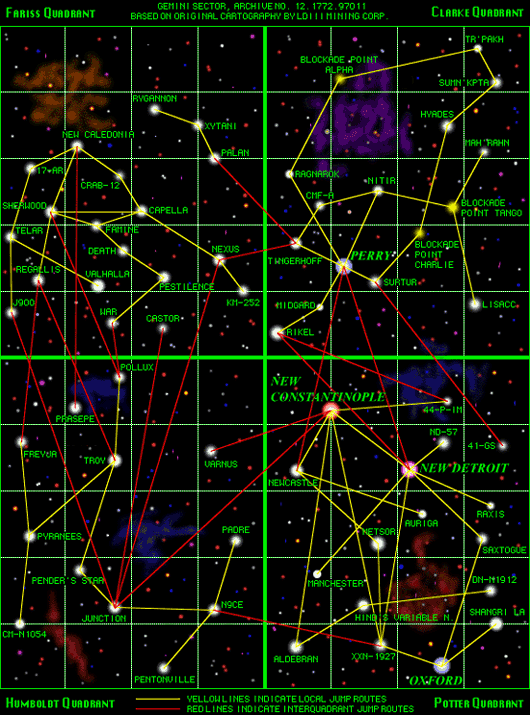
Wing Commander: Privateer is the successor of the game Elite. It's probably the best example of what to do in a campaign setting such as this.  Privateer  allows the player to really play in an expansive universe that immerses you in an expansive universe (although its only relegated to the Gemini Sector -- a sector built around the Gemini constellation in the Zodiac).   There is essentially three paths opened to you: you can be a free trader, a mercenary, or a smuggler.  What is best about the game is it's openness.


What does Selling the Moon, Wholesale offer you and your players?

Using Wing Commander: Privateer as a model, this model offers both the GM and the Players Dungeons and Dragons styled like scripting and running.  The game is made up of three separate elements that ensure player freedom.  They include:

* Random Encounters among space lanes.
* Small missions brokered by Independents, the Mercenaries Guild and the Merchants Guild
* Fixer missions.

Random Encounters

Although not in vogue among the RPGA, a Random Encounter system is great for Selling the Moon Wholesale because you can use Random encounters to set up your players with a bit of randomess against any NPC factions you have working in your universe.  Like pirates, retroes, or enemy Space Nations (like the Kilrathi [space cats] or the Magog [space orcs] for example).

 Small Missions

Small missions are GM created missions that usually don't need anything beyond an objective and random encounters.  They can be written down on 3x5 cards with stats for spaceships and who is flying them.  They can also include generated star systems for planets or drifts you can visit.  Small missions are brokered by organizations through your Merchants Guild, your Mercenary's Guild, or a concourse kiosk.

Fixer Missions

Fixer Missions are full blown adventures -- written by you or published.  They are brokered by NPCs, and provide you with a true plot and campaign scripting within your universe.  Some examples are the old SpaceMaster Modules from ICE or the old modules from Star Frontiers.  Even Gamma World modules may work with some rewriting.  The Old Privateer game had a main campaign, find out how to destroy the egg that has been plaguing shipping lanes.  While this strung people along, as a GM you don't have to string your players along in a campaign such as this.


Choosing your Game System

The Choice of a Game System is pretty important when running a game.  You need a good game system that will provide fun for you and your players.  Published game systems include:

  1. Traveler
  2. SpaceMaster: Privateers
  3. Star Trek: The Next Generation Roleplaying Game
  4. Star Wars Saga
  5. GURPS
  6. Star Frontiers
  7. Alternity
  8. d20 Future
  9. Big Eyes, Small Mouth 
  10. BESM d20
Of the games above, I tend to make a mishmash.  I use GURPS: Space and LUG's Star Trek: The Next Generation Roleplaying Game for my Gamemaster advice, and SpaceMaster: Privateers as my system of choice.  The latter is crunchy enough to handle both Space Opera and Hard SF settings.   While the earlier provides some Good Advice!  The old LUG Trek game has the best advice on making system settings (called sectors), while GURPS Space provides some good all around advice.

That is just my set up, you can use whatever game you enjoy for you and your players.

Choice of Setting

So what is left is choosing a setting.  From Star Trek to Privateer to Andromeda to Blue Planet there are a lot of published settings you can use.  Even Space 1899 and Space 1999 are not impossible!  Lets use Privateer as an example.

The game starts you out in the Gemini Sector, in the Troy system.  The Troy system has a terraformed planet (Troy 3, I think -- known as Helen), and two Mining Bases (Hector and Achilles) with jump points to the Pollux, War, Regallis, Pender's Star, and Pyrannees systems.

you allow the players to either create their own ship, or give them a Taurus scout ship (note, if they create their own Hyperyacht, do not give them starting money!).   You also can start them on Helen (which is a Garden planet) or one of the mining bases.


On a base in Privateer, the players have access to the concourse -- which provides offices to the Mercenaries Guild, the Merchant's Guild, a ship dealer, a commodity exchange, a bar, and a mission kiosk.  As GM, on certain bases, you can expand the concourse to include a mini mall in which players an buy new clothes and food for their ship (maybe even get a food replicator).

The mission kiosk is where you can dispense your "mini" missions, and the Commodity Exchange is where the players can buy commodities to buy and sell on the open (and black) markets.

There are some interesting things about the Privateer universe.  There are a couple of base types the players can fly too:
  • Agriculture planets
  • Mining Bases
  • Refinery bases
  • Pleasure Planets
  • Pirate bases
  • New Constantinople (the Capitol)
  • Perry (Military Base)
  • New Detroit (Refinery and Manufacturing center)
  • Oxford (University planet)
And there are factions.
  • Militia -- citizen Space police.
  • Confed -- Galactic Confederation Military (Earth controlled, of course)
  • Retros -- The Church of Man, a bunch of religious fanatics that want to take away your electric razor.
  • Pirates -- yes, you know who these are.
  • Bounty hunters -- the Competition in the Mercenary market, these citizens are space Vigilantes.
  • Merchants -- Your competition in the Merchant market
  • The Kilrathi -- Humanoid cats which are more like D&D Hobgoblins with their own politics and agenda.  Do not think of them as orcs . . . that's for the Magog.  The Confederation is at war with the Kilrathi.


Plus there are a bunch of NPCs you can lift from the game.  


There is a lot you can do, and I hope I gave you a lot of good ideas.  If you enjoy science fiction gaming, the sky is literally the limit since there is a whole goldmine out there just waiting for you to explore!

Sunday, January 9, 2011

The Record of Lodoss War

 
If you really want to see a series that is full of D&Disms, and is quite serious about its subject matter, the High Fantasy Anime Record of Lodoss War is perfect for your appetites.  The series chronicles the adventures of Parn, Deedlit, Etoh, Slayne, Woodchuck, and Ghim as they have misadventure after misadventure brought on by the Island of Marmo and Karla the Grey Witch.

The series itself is directly based on Dungeons and Dragons (BECMI or the real 4th Edition) where there is a Fighter (Parn), Cleric (Etoh), Magic-User (Slayn), Thief (Woodchuck) -- all human of course -- and a High Elf (Deedlit) and a Dwarf (Ghim).  The only character missing is a halfling.  As it happened the Dungeon Master of the original Lodoss War campaign came to America looking for inspiration.  He bought the Dungeons and Dragons game and went back to Japan.

He created the world of Lodoss and set his players on a series of adventures that were recounted in the pages of a Japanese Magazine.  The series takes a lot from the Lord of the Rings (are you really surprised?) as Ghim is actually based on Gimli.  The sad part, for Americans, was that the Campaign Setting was pitched to TSR, Inc. but was rejected.  What was America's loss is Japan's gain actually.  The series Dungeon Master wrote a RPG of his own to publish his world with -- called Sword World RPG.  The series was eventually released in America, though, on DVD as an Anime Series and not as an RPG Campaign (along with the series).  A sad thing, really.  After talking about Classic fantasy, I'm bringing up a High Fantasy world.  Now why would you think that?

The Record of Lodoss War and the Slayers, which will be detailed next, along with other anime set in the Western High Fantasy genre; are the inspiration for the Dynamic Spellcasting System.  Like I said before, the Spellcasting System is designed to replicate what you see in these sorts of Anime (and read in books).

It's a tradition now lost in the D&D RPG, since Wizards redesigned the system to take much of the wonder out.  The Powers System -- which doesn't fit High Fantasy at all -- is more of a fit for the Magical Girl genre of Anime.  Sailor Moon, Card Captor Sakura, and Sakura Wars fit Wizards of the Coast's new incarnation of the game more than Record of Lodoss War and The Slayers now do.  Eh, all in the name of Balance, I guess.

However, the Biggest secret of roleplaying isn't the rules; its the world and then the rules you make up as you go along.  You really don't need D&D to play Adult styled Make-Believe.  Just create a world and play as you go along.  The stuff that Wizards foists on gamers is really unneeded.  There are thousands of RPGs on the Market, and you can always make one up as you go.  The D&D game is just a start -- the idea is to figure out when you're ready to break through and go independent.

Sunday, January 2, 2011

Several Spells of Wonder

I have an idea that could be a good test of the OGL. Copying some spells from the Book, More Magic and Mayhem as wizard spells for use in Pathfinder. The spells are:

Fire Bolt

Shadow Bolt

Fireblast

Combustion

Immolate

Conflagrate

Soulfire

:D

Just a crazy Idea I had.

Wednesday, December 8, 2010

World of Warcraft Adventures Wiki gone live!

I started a new Wiki for the World of Warcraft RPG.  Called Adventures in World of Warcraft I originally thought of doing it up for Quel'thalas campaigns.  However, since the World of Warcraft is ever reaching and encompasses quite a large area, I opening up the Wiki for every World of Warcraft fan to record their adventures for everyone to use.  The spirit of the site is sharing.  Sharing your adventures set in World of Warcraft to everyone.

We will accept adventures written for the RPG, or written for 4th Edition, or for Pathfinder, or for most any system you please.  As long as you mark what system the adventure is for.  Players and fans may write adventures for any era to share with other fans of the pencil-and-paper side of the franchise.

Thanks for reading! :D

Elton.

Sunday, December 5, 2010

The Caves of Chaos


My, my.

Finally we get the PCs up and going for the Caves of Chaos!!  It's finally happening, the PCs (well, 2 of them) are finally ready to go into the Caves of Chaos.  The problem seems to be that Rolemaster PCs at first level are woefully underpowered against their D&D counterparts.  For instance, at 2nd level, an RM magician gets a plasma bolt -- SHOCK BOLT -- it's called (in D&D 4e, it's an at will power called magic missile that clueless idiots get to cast at the Darkness every time they feel like it while their fellow player wants to do some chicks at the local tavern.  Stupid thing should be a DAILY power).  Ahem.

This is Rolemaster, not the cartoonish thingy of 4th Edition.  People get hurt.  People get maimed.  People bleed.  People get their limbs hacked off.  People get hit by Interplanetary bolts of lightning and light up like Christmas Trees.  That sort of thing.  So what is terrible about a D&D dungeon crawl when you rolemasterize it?  They, the players, are facing greater odds.  There aren't five gnolls that fall down every time you zap them, there are five gnolls that can really kill your character -- with experience comparable to level 1 D&D characters.  But there is a reason why the PCs are going into the Caverns of Chaos.

The Drow of the Underdark is infiltrating the government of Evereska.  They killed the Queen and they dumped her body in the Caverns of Chaos.  The elvish government need proof before they can act against the Drow in Evereska.  That proof, the body of the dead queen of Evereska, is in the Caverns of Chaos.  A place most sane people would stay away from.

Even if your players play fourth edition and have gnolls for breakfast. 

Wednesday, November 24, 2010

Obligatory Naked Elves Render

 
In my adventure I'm writing, the Gray Wolf Tribe has contact with mountain wild elves that has totally gone native.  In other words, they are a clan of naked elves.  Why they did it?  No one hopes to fully understand the minds of the elves.

Actually, in truth, the body is good and wonderful and our compulsiveness to cover up the body even though the Son of Man had atoned for us and gotten rid of the effects of the Fall is completely in comprehensive.  The Father meant for his Children to be nudists.

Friday, November 12, 2010

Review of the Eberron Player's Guide


Byline: It still misses that Old Dungeons and Dragons magic.

The Eberron Player's Guide misses that old Dungeons and Dragons magic.  It suffers from the same writing style as the 4th Edition PHB 1, but not nearly so much.  There are several things changed that I don't agree with cannonically. Having the original Eberron Campaign Setting (and still in GOOD CONDITION!) there was some significant changes made to this edition.  Plus, Keith Baker wasn't listed as a writer, so I wonder if he had any input at all.

That being said, I don't think you need the DM's Guide at all if you have the original setting except for the monsters (Karnnathi Zombies, Skeletons, Dolgaunts, and so forth).  You can get most of the changes from the Player's Guide. The first chapter, Life in Eberron explains what Eberron is like today and yesterday.  This chapter introduces you to the basics of the setting. Bringing back some of that old magic.  It goes and explains the world of Eberron.  From Khorvaire and Sarlona; to Aerenal, Argonessen, Xendrik, and Everice.

It then explains the planes and how they work.  what life is like across Khorvaire,  how the governments work, what everyday life is like, how money works, and the languages work.  It's also how naming works.  They also talk about the gods and their alignment, and the other religions and how they work. It also goes into the current age, and the calendar.   Then all the other items of Eberron is presented towards the player's point of view.


The Races chapter goes into the individual races.  From changelings, to Kalashtar, to the Warforged; each of these are presented in the same format you see in PHB 1.  What a tragedy.  But each are described in detail (note, though, the Races of Eberron book for 3e goes into far more detail about these races).  Two of them haven't changed much to their 3e counterparts.  That would be the Warforged and the Changelings.  The Kalashtar, however, had an enormous change.  They are granted the bastion of Mental Clarity power.  They still have inborn telepathy -- but it's treated as a language.  IF you want to play Kalashtar to their greatest effect, buy a copy of PHB3 and the Psionics expansion book.  The only race that isn't presented is the Shifters in this section.  What's wrong, Wizards?  Can't you reprint the Shifters from PHB 2?

Beyond that, they go into the Core races and the not-so-core races and where they fit in Eberron. What is nice is that they tell you where everyone fits.  And the Dragonborn came from -- you guessed it -- Argonessen and are based in Q'Barra.

So, you get into classes and how they fit in Eberron in Classes.  You get dozens of paragon paths, and epic destinies.  You also get some new feats, equipment, and magic items in Character options along with some new rituals.

The five nations are talked about in The Five Nations chapter.  What is common knowledge about them, and how to work in the five nations and how the PCs relate to them. It also talks about Sharn and what is going on in the Mournland (Cyre).  It also talks about what is going on beyond the Five Nations and Beyond Khorvaire from a player's perspective.  Finally it went into a large amount of backgrounds.

Conclusion

Yeah, I bought it for $29.00 (with added tax).   Was it worth $29.00?  Compared to coming Hyper-inflation . . . YES!  ahem . . . in 1910, I could probably get this for 5 cents, maybe 25 cents.  In 2012, this same book will cost you $80.  Sorry, that's the way it is.

Despite this, I think that I could run a 4e game with is, almost.  I have the original ECS, so I can't run out of plots.  Really.  Well, I guess.  Maybe.  No, definitely.  I don't like 4e, but I like this book.  If you want to run Eberron with 4e, this book is needed.  But if you have the original ECS, it's not worth it to spend the extra 10 just for monster stats.  You're best bet is to extrapolate them from the original 3E book.

Wednesday, November 3, 2010

SpaceMaster New Space update

I've begun to post my Spacemaster campaign on the RPGnet wiki.  Called SpaceMaster: New Space, for lack of a better name.  Writing this took most of the day.   Especially for a game inspired by Microsoft Freelancer and Origin's classic Privateer.

The campaign is fairly different from the above two.  It takes place in 1982, with the associated microcomputer in development (2 to 4 bytes per second).  However, some planets have computers that exceed this limit, but hasn't broken Bode's Law.

Items added today:
Scro, Eldar, the Massachusetts System, and Planet Akihabara in the Honshu System.

Monday, October 25, 2010

My Spacemaster Campaign

236084main MilkyWay-full-annotated
By NASA/JPL-Caltech/R. Hurt[see page for license], via Wikimedia Commons; in the Public Domain


It's the Year 1982.

Twenty Years earlier, the Illithids were defeated in a major Interstellar War against the Nations and the Powers of World War Two.  The Allies and the Axis joined together to fight the Illithids.  Using FTL capability given them by the Eldar, the Earthers fought a major campaign to keep their independence and right to live.

The Earthlings defeated the Illithids at the Battle of Orion in 1962, forcing them to withdraw their imperial interests out of the Orion Spur.  The Illithids still have a far reaching empire: in the outer arm, the Perseus Arm, the Norma Arm, and the Scutum-Centaurus Arm of the Milky Way Galaxy.

Mankind has settled the galaxy some forty light years beyond Sol.  Each Nation, except the USSR, formed their own stellar nation and their citizens raced to these new nations to start new lives among the territory that the Earthers conquered from the Illithids.  But the Illithids are still out there, biding their time to plot revenge.

This image of the "Mind flayer" creature (concepted by TSR Inc. and Wizards of the Coast) is a from-scratch fan drawing.

The Illithids were utterly defeated, but there are planets within the Orion Spur where some are still rumored to exist.  The defeat did not come easily, but victory meant that the humans had new worlds to settle that were under Illithid Domination.  And in the far Frontier, skirmishes between Illithids and Earthers are uncommon.


TECHNOLOGY OF THE EARTHERS

The Technology of the Earthers are simple, it's rivets and steel.   While the Illithids use organic hulls on their space ships, the Earthers use strong Fullerine hulls.  While the Eldar use wood, the Scro also depend on metal.

Space Drives

Human Technology depend on a Plasma Ion Propulsion drive for space -- which is similar to a fusion reactor drive, but plasma is used to foster the fusion process and the resultant ions are forced out of the nozzles.  While in air, propulsion is based on a reactionless electromagnetic gravity drive.  The Earther ships are able to produce electromagnetic fields around their ship that causes the ship to counter gravity and lift themselves up.

Humans depend on two star drives: the Plasma Slipstream Drive and the Fold Space Drive.  The Plasma Slipstream Drive creates a Birkland Current around the ship and slips it into Faster Than Light travel.

Plasma Slipstream, in action.  (From Stargate Universe)
The second method of travel is a fold drive.  Carried on the largest of ships (such as space battleships and space carriers) the Fold Drive is a quick way of transporting a large amount of ships to another part of Interstellar Space as quickly as possible. Developed in 1960, the Fold Drive was used to transport five Earther Fleets to the Orion Nebula where they dealt with the Illithid Armada that amassed to conquer the Earthers.  However, the Illithids had trouble of their own and the Earthers had allies: the Scro, the Eldar, the Draconids, and other races in the Galaxy.  They defeated and destroyed the Illithid Armada in the Orion Spur.  Their power broken in the Spur, the Illithids retreated their own holdings in other parts of the Galaxy.

Drive Speed:

The new generation of Plasma Slipstream Drives allows ships to go at 7 parsecs a day.; this pretty much means that a ship traveling from Earth to Alpha Centauri at about 4.5 hours, to Canopus (which is 30 parsecs) about 4 days of travel; and Across the Galactic Arm, which is 2,000 parsecs: about 9 months.  It takes 4 years to reach the Plasma confluence at the Galactic Core -- a distance of 10,000 parsecs.  The Fold Drive system can carry ships up to a maximum of 50 light years per use.  Most people prefer to use the Plasma Slipstream FTL if they can help it.  The first generation Fold System is very temperamental and unreliable.

Fuel

Earther Ships rely on Plasma Fusion Generators to generate ion thrust and electrical power for the ship. However, the Zero Point Energy Converter is still experimental, as it would convert Zero Point Energy into electrical power and propulsion power.  The fuel capacity for Plasma Fusion allows a ship to have a range of 20 parsecs non-stop.

Star Fashion, by myself.


FTL Astrogation

FTL Astrogation is Complex and 3-Dimensional.  The course must take into account the gravitational fields of intervening suns and star drift.  A reliable course (Astrogation, Medium) can only be computed if the Astrogator has complete information about the system.


Communications

The communications of the galaxy depends on FTL communication via a tachyon network.  While frontier planets depends on courier ships; planets closer to Sol uses the Tachyon network.  Courier ships use Fold Systems to get from place to place, though, delivering the news.

Computers and Cybernetics

IN 1982, the Intergrated Circuit is still in its infancy.  Computers have the power of a Apple IIe or a TRS-80 (pronounced trash 80) or an IBM computer with only 128 kilobytes of memory.  Calculations and programming are done by Machine Language (COBOL), C, and Microsoft BASIC.  Spreadsheets and Databases keep the computer banks informed.  However, most ships have mainframes that carry 10 GBs of storage.  Given the computer's level of evolution, however, Energy Matter Teleporation by machine is necessarily impossible.


Gravity Manipulation!

Gravity onboard ship is achieved by using electricity to produce the necessary Gravity aboard ship.  Electricity is 10 to the 39th power much more powerful than gravity.  Conversely, a ship is capable of generating powerful electromagnetic fields to counteract the effects of gravity, in order to lift itself into space.


Next Post: RACES!

Friday, July 23, 2010

Remember Morrowind?


Morrowind was a game that said you can do anything you like.  Even raid sacred tombs for important stuff.  The guide to Morrowind was packed with locations that had all sorts of juicy bits.  Although Morrowind wasn't as BIG as Daggerfall, the game had giving you a lot to do and explore.  A roleplaying game adventure should have these options, although usually page count prevents the writer from including some options.

Each option would be a treasure or an encounter.  I started to do this with my Atlantis adventure, almost absent mindedly.  The PCs would go there, raid a tomb, and have some fun.  Or an option led you to a strange encounter, or some treasure in some unusual places.  (in my Atlantis adventure, I already listed some interesting encounters - a Bronze Dragon and an abandoned pirate's cove).

The idea is to have fun with an adventure or video game.  I'm off to play more morrowind!! :)  And yes, I usually play a Telvanni. :)

Saturday, May 1, 2010

Chapter 2: Character Races

Chapter 2: Character Races for Galatea: the Caithness Isles is mostly complete.  The races you can play include humans, eladrin, high elves, Massalian elves, wood elves, orcs, trolls, dwarves, gnomes, goblins, trolls, and Tieflings.  Do you want to see halflings as well?

The next in the project is going to be Character Classes.  I'll be adding a few new Character Classes to the game from the World of Warcraft Roleplaying Game.  These character classes include the Shaman, the Warlock, the Hunter, the Inscriber, and the Runemaster.

The Shaman is a class that deals with the spirit world of Galatea.  Shamans usually lead tribal people through their spiritual and mythic journeys and use spells that have to deal with spirits and the elements.

The Warlock practices demoniac magic and usually has an evil outsider as a companion.  Some warlocks often fight corruption, while others revel in their corruption.  Warlock magic is an easy gateway to evil.  Although some warlocks prefer to fight fire with fire and not even think about the possibility of corruption.  They use the magic of demons to fight demons.  In the Caithness Isles, the Warlock replaces the summoner class.

The Hunter does not replace the ranger, but acts as a complimentary class.  The hunter specializes in hunting and using animal companions to help him on the hunt.  Hunters are also artillery specialists, often specializing in the bow and arrow and imbuing the bow and arrow with mystical properties and expanding their pets' capabilities.

The Incriber and the Runemaster work with the runes of the world.  The inscriber is more of a traditional spellcaster except they cast their spells through runes, sigils, and glyphs.  The runemaster, however, tattoos his body with the same runes, sigils, and glyphs to increase his offensive power and control.


After that, I'll be talking about how the other classes work in the campaign.


Now working on: CHARACTER CLASSES

Monday, March 2, 2009

4e Classic Play

Clark Peterson over at Necromancer Games is trying to make 4e feel better for us who enjoy our D&D in certain recipes. What he is doing is taking out the heart of 4e as it is now, and transplanting it with the heart of AD&D or OD&D.

Although I said my piece on the forums, I think the idea is good and sound. For me, I want to play a 4e game where it's gritty and the danger is real. Heroism comes from with in, and unless you are playing Superheroes with the conviction that someone has got to save the world, I'd rather play 4e with combat where it's scary (combat should be deadly and lethal).

When I chimed in, Clark said that 4e isn't really for me, and yeah he's right. But when, or if, I DM 4e I'd like to DM a game I'd be more comfortable DMing. And Clark is going to attempt that. Pop on over to the Necromancer Games' forum and take a look at what he's doing and say hi!

http://necromancergames.yuku.com/forums/81

Wednesday, January 28, 2009

Classic Dungeons and Dragons and Rolemaster


Did you know that the Rolemaster supplements were designed to supplement Classic D&D? Classic Dungeons and Dragons the grand daddy of all RPGs that is based either on pencil and paper, the computer (CRPGs and MMORPGs, is there such a thing as a Massively Multiplayer Online RolePlaying Game?), or Live Action (although Live Action roleplay has been existing for seven thousand years).

Classic D&D allowed you to do anything you put your imagination too. You want to fight a dragon, just make a cave, a dragon, and something you want that the dragon wants and has (like a princess). And go at it. There wasn't any thing complex to Classic D&D, and you just played it to your heart's content. There was nothing stopping you and your friends from having a good time.

However, along the way, several supplements were developed. Sometimes by third party publishers. One of these publishers was Iron Crown Enterprises. They developed three products that helped D&D play greatly, adding a sense of realism.

The first of these was Arms Law.

Arms Law (2003)
Arms Law brought to the table new rules on how to handle combat. Although the Weapon Mastery rules were wonderful in their own way, Arms Law brought realism to the fore of combat; introducing concussion hits, critical strikes, and what would happen if you were critically striked by a weapon or a claw. It came in two supplements: Arms Law and Claw Law. These were eventually merged into ARMS LAW, like you see on the left (which is the 2003 Revision).

This brought Classic D&D on a more dangerous level. Not only can your character die, but can die from a critical strike. Here's one infamous critical strike from said book:


Strike to foe's groin area. +10 hits. All vitals are destroyed immediately. Foe is stunned and unable to parry for 12 rnds and then dies.

That is the E critical Strike from the slashing table with a result of 100. That means any foe, of any level, can die instantly or after a period of time (ie. 12 rounds). This made playing D&D much more lethal to your character, but instantly more fun since it added the realism some players so craved.

Spell LawNot to be outdone, we have Spell Law. Besides adding rules for weapons, we have rules for spell casting; a lot of new spells to work with, and -- the happy Critical Strikes that such spells can cause.

So, not only can your character die by slashing hits, bludgeoning damage, crushing blows, and the Full Nelson, your character gets to be blown up -- and be blown up -- in style.


For instance, to quote the Fire Ball critical result table:

All that remains of foe are charred bits of teeth and bone. Add +20 to your next roll.

Doesn't sound like a walk in the park: for you or for your foe, right? But that is exactly what would happen if you cast a fireball spell at somebody! I refer you to the video above to see how dangerous fire can be if you don't believe me. Spell Law brought that kind of realism to the Classic D&D game.

Rolemaster Classic Finally, we come to the third installment to the series, Character Law. Character Law is designed to bring advanced character development to the Classic D&D game by allowing you to define what your character is capable of. This went so far as to define what your character knows: in terms of total basic knowledge that pertains to adventuring (hiding, swimming, running, etc.). The rest: such as where your character came from, how he got there and what he does on his spare time; was up to you.

So there you have it: Rolemaster is really a Classic D&D toolkit. These supplements enhanced everything pertaining to Classic D&D: weapon and combat rules, critical strikes, spell effects, and defining your character.

These concepts were eventually adapted into the D&D game little by little. Today, 4th Edition Dungeons and Dragons exist -- a game that has been influenced by ICE's game -- Rolemaster. Also, today, Rolemaster has evolved into a perfectly good game by itself. You can play Rolemaster by itself, or added to D&D. However, as for what Rolemaster has been designed, I suggest classic D&D.

Related Posts Plugin for WordPress, Blogger...